Showing posts with label Doug Harvey. Show all posts

Tuesday, March 16, 2010

Before Doug Harvey Ruled the Habs Blue Line…

I was in the midst of researching for an upcoming piece, and came across this little blurb from the November 13, 1943 edition of the Montreal Gazette.

Harvey_fb_Nov43 I had made mention of Doug Harvey’s multi-sport prowess in an article I put together on the anniversary of his death. I was quite surprised to find this though.

This truly demonstrates Harvey’s abilities, as a football player, all the while playing Jr. and Sr. hockey at the same time. Many felt that Harvey was an even better football player than he was at hockey.

World War Two would change things, as Harvey would go on to serve his country in 1944, and the football club he left behind would go on to win the Grey Cup.

By the time the war ended, Harvey’s thoughts of football were long behind him as he began playing pro hockey full team and was with the Montreal Canadiens for the 1947-48 season.

Alf Harvey: I have had little luck finding any info on Doug’s older brother. The SIHR player database does show an Alph Harvey, who played a dozen games for the Montreal Jr. Canadiens in 1941-42 and recorded 11 points (7 more points in four playoff games). It also shows he played in single games with the Montreal Jr. Royals and Ottawa Royal Signal Corps in the following seasons.


Saturday, December 26, 2009

Remembering Canadiens Legend Doug Harvey

DougHarveyHockey4448 I remember sitting at home, on Boxing Day 1989, when I heard the news that Canadiens legend Doug Harvey had passed away at the age of 65.

Harvey had retired from playing almost a year before I was even born, but I was well aware of the Hall of Fame blue liner, and what he brought to the game.

While many legends, that I grew up watching, relied on speed and physical play, Harvey’s ability to control the tempo of the play is what set him apart from the rest to this day.

Many still debate who was the better defenseman, Orr or Harvey.

Harvey would slow the pace of the game down, looking up ice to see who was on the ice and where they were going.

HIs style of play actually frustrated not only the opposition, but also his teammates, and coach Dick Irvin, when he first began playing for the Canadiens in 1947.

Soon they realized the benefits of his tactics. Harvey knew that he wasn’t necessarily the fastest player on the ice, but that a moving puck could get up ice faster than most skaters.

Combined with his defense, vision and stick-handling abilities, Harvey made it a habit of drawing in forecheckers, then setting up and odd-man rush with a quick up-ice pass.

Doug_Harvey4549 "I'm not throwing any pucks away," he said. "I'm trying to do what's best for the team. That's why I take my time and make the play."

Though not a hard-hitting defender, he did play a very physical game and a tremendous ability to free the puck from opposing attackers.

With his forwards able to play up ice in a transition game, and rely on Harvey, Emile Bouchard, and later Tom Johnson holding court on the blue line, fire wagon hockey was born.

Harvey’s play would help the Canadiens win the Stanley Cup in 1952-53.

It was interesting to note that after Elmer Lach’s overtime winner, in game five, Harvey did not stay on the ice to shake hands with the Boston Bruins.

"I'm running them into the boards and banging them around one minute and because we win the Stanley Cup, that's going to change? I don't really like them anyway. Why should I shake their hands?"
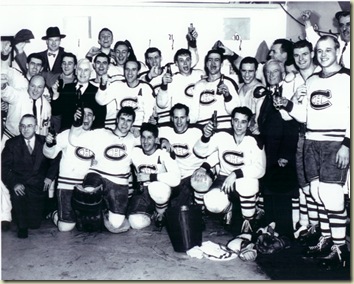
19-team-semi-51 The following season, the Canadiens were back in the finals, where Harvey was the victim of his own-goal in the game seven overtime against Detroit.

He didn’t let the error affect him though, as the following season he won the first of seven Norris Trophies as the NHL’s top defenceman.

“When I joined Montreal,” said Jean Beliveau, “He was the best defenceman I’d ever seen.”

As the Canadiens began their dynasty of five straight Stanley Cups, Harvey was the quarterback of one of the most dominating power play units in NHL history.

It was so effective that the NHL had to change the rules, in 1956, to allow a penalized player to return to the ice once the team with the man-advantage had scored.

Harvey had run of four Norris Trophy’s from 1955 to 1958. His defensive partner, Tom Johnson, would win it in 1959 before Harvey reclaimed it yet again the following season.

With the retirement of Maurice Richard after the 1959-60 season, Harvey was named captain of the Canadiens.

It would be a short tenure however. Despite being known as a good team leader on the ice and in the room (many felt he should have been named captain over the popular Richard), his relationship with management began to diminish.

image

Along with other players, Harvey had been attempting to form a players association when they learned that the owners were not matching the players pension contributions.

The attempt went without success and Harvey was essentially blacklisted, as he put it, by the league.

The rift between Harvey and Canadiens GM Frank Selke was further escalated by his alcoholism and bi-polar disorder.

Harvey was notorious for being the last player to get on the bus or on the train, according to assistant GM and former defenseman Ken Reardon.

He also appeared at a formal event in a Tuxedo and running shoes and once skipped a team dinner to go drinking.

“I’m my own man,” Harvey said. “This is who I am.”

Reardon and Selke felt otherwise and something had to be done.

“As a front office man, you don’t want him as captain,” Reardon said.

269

At the end of the 1960-61 season, after winning his sixth Norris and ninth First Team All Star selection, he was traded to the New York Rangers.

"It had to do with union activities," Harvey said on the trade. "I was a First Team All-Star and won the Norris that year. You don't give away a player like that!"

He has a valued point as Ted Lindsay, another involved in the players association attempt, was traded to the Chicago Blackhawks three years earlier.

“I would have been traded earlier,” Harvey once said. “But we kept winning all those Cups. Selke knew if he traded me then, the fans would riot.”

Harvey fought to stay in Montreal but realizing that he had no choice in the matter, reported to the Rangers.

As the last player-coach in NHL history, he won his final Norris trophy and First-team All-Star awards while leading the Rangers to their first playoff birth in three seasons.

He stepped down as coach to focus on playing with the Rangers for two more seasons.

“I liked playing best,” he said. “Being with the boys, having fun and tossing back a few after the game. I never really liked coaching that much.”

Left unprotected by the Rangers in the 1963 intra-league draft, he signed as a free agent with the AHL Quebec Aces. Harvey would play for Quebec, Baltimore and Pittsburgh over three seasons before resurfacing in the NHL, for two games in 1966-67, with Detroit.

With the NHL expanding to a dozen teams, Harvey became player-coach of the St. Louis Blues’ AHL affiliate in Kansas City.

doug-harvey

 one_harvey05

He would be called up by the Blues in their playoff run during the 1967-68 season, and played all 70 games for the Blues in the following year.

At age 44, he retired from playing.

Harvey stayed in hockey as an assistant manager for the WHA’s Houston Aeros. He is credited with convincing the Aeros to sign two underge brothers, Mark and Marty Howe, to pro contracts.

Once they were signed, their legendary father, Gordie Howe, came out of retirement to play with his sons.

The question of being black listed comes into play once again in 1972. With his credentials, Harvey should have been elected into the Hockey Hall of Fame that year, but he wasn’t.

It was the same year that Howe and Jean Beliveau were exempted from the three-year waiting period.

“They don’t want me in there because I’ve been known to hoist a few,” Harvey said never afraid to speak his mind. “And they’ve never forgiven Ted Lindsay and I for helping for the NHLPA. We were blackballed when we did that.”

For the record, Ted Lindsay was inducted into the Hall of Fame in 1966 and also was exempt from the three-year wait.

On July 5, 1973, the Hockey Hall of Fame sent a letter out to Harvey congratulating him upon his election to the Hockey Hall of Fame.

Fifteen days later, Harvey’s wife Ursula replied to inform the Hall of Fame that Harvey had refused to accept his election, despite talking to him over the phone the night before in hopes of changing his mind.

Instead of spending the day when a player has achieved a pinnacle of personal success, Harvey spent the day fishing and drinking.

During retirement, Harvey went into a nomadic lifestyle, travelling across the country.

Many believe he was homeless and living in a boxcar. Truth of the matter was, it was a mobile, and rather elaborate, unit once owned by John Diefenbaker for visiting dignitaries. Harvey’s home-base was set up on a raceway, just outside of Ottawa.

One of hockey’s greatest players had virtually vanished into obscurity.

In 1984, Harvey had stopped drinking. At the same time, on their 75th anniversary, fans of the Montreal Canadiens selected an all-time All-Star Team.
1habs_harvey_50082 Jacques Plante was chosen as goaltender, the forwards were Jean Beliveau, Dickie Moore and Maurice Richard while the blueliners selected were Larry Robinson and Doug Harvey.

The group, along with all-time coach Toe Blake and Aurele Joliat made a memorable appearance in uniform before the Forum crowd.

On October 26, 1985, his No. 2 was retired by the Canadiens and he was hired on as a part-time scout.

image

Harvey was diagnosed with cirrhosis of the liver in 1988 and died a week after his 65th birthday in Montreal General Hospital in 1989.

“I feel very,” said Maurice Richard on his passing. “We had a lot of fun together. Doug was great, always willing to help.”

"If I had to do it over again," Harvey said shortly before his death. "I wouldn't have changed a thing."

He truly was his own man.

3825787769_83c7b901fc

Did you know?:

dougharvey_1943

Doug Harvey began playing hockey as a goalie, but was moved to forward.

He was a multi sport athlete in high school and played hockey for the school throughout his years at the school, although somehow was excluded from the 1941 Senior team.

In 1942 he was moved from centre to defence by coach Jack Black, and in 1943 his school won the city championship.

He was touted by the Boston Braves to play baseball, and also had a chance to play pro football, before signing on with the Royal Canadian Navy, where he won the Navy boxing title.

Friday, December 4, 2009

The Montreal Canadiens 100 years, 100 photos

For the Montreal Canadiens Centennial, I decided to put together an assortment of photos and images featuring hockey’s most storied franchise.

Some will likely be familiar ones, but I’m throwing in a few more lesser known ones as well.

To see the full size photo album, just click here.

Congratulations to the Montreal Canadiens on their Centennial!

Here's to another 100 years!

Wednesday, December 2, 2009

Habs Twelve Days of Trivia Contest: Day 2

P1060001

It’s day two of my Twelve Days of Habs Trivia!

Each day, from December 1 to December 12, I will post a trivia question about the Montreal Canadiens.

Don’t worry, they won’t be too difficult.

Once all the questions are posted, send me an email with all twelve answers.

Entries must be received by December 14, 2009.

All correct entries will be placed in a hat, and the lucky winner drawn.

The Prize pack will consist of:

  • A DVD copy of the original series of “Peter Puck : How to Play the Game”
  • Five packs of cards from the Canadiens Upper Deck Centennial Set
  • A set of reusable Montreal Canadiens Stickers
  • A Montreal Canadiens bumper sticker
  • A die-cut indoor/outdoor magnet
  • A collection of four 1/64 Die-Cast Canadiens vehicles
  • An assortment of 50 Montreal Canadiens hockey cards with some nice surprises in them

The prize pack will have an approximate value of $50.00

Good Luck to all!

Here’s trivia question number two:

Multiple Choice: Doug Harvey won seven Norris Trophies with the Canadiens. In which of the seasons listed below did he not win it?

a.) 1957-58

b.) 1958-59

c.) 1959-60

d.) 1960-61

Monday, July 6, 2009

Who will lead them?

Well the Montreal Canadiens roster officially got trimmed by one more player.

Despite a “rally of the masses” on Sunday afternoon at the Bell Centre, Habs GM Bob Gainey told CJAD radio on Monday that Alex Kovalev would not be returning.

 Fans rallied Sunday to keep Alex Kovalev in Montreal

Hours later, Kovalev took the money ($10 million over two years) and ran up the highway to Ottawa Senators.

The Northeast Division will be fun to watch this season without a doubt.

With Kovalev’s departure and the likely signing of Saku Koivu to either Buffalo, Atlanta, Anaheim or whatever square Eklund’s rumor dart hit this afternoon, this leaves the captain and all assistant captains off to greener pastures.

Mike Komisarek defected to the Toronto Maple Leafs on July 1 and Christopher Higgins was traded to the New York Rangers on June 30.

The question now has to be asked, who will be the next captain?

Andrei Markov has been an assistant captain in the past but is unlikely as a captain.

You have to remember that Koivu was criticized for not speaking French. Markov can barely speak English so it’s safe to rule him out.

The Kostitsyn brothers??? Georges Laraque ??? Forget it!

Scott Gomez seems to be an early popular choice, despite not playing one game for the Canadiens.

Sorry Mr. Gomez, but there’s too much tradition to just walk in and take the “C”.

Ditto for Mike Cammalleri and Brian Gionta.

All likelihood two of these three will be alternate captains.

Young bucks Josh Gorges, Maxim Lapierre and maybe Guillaume Latendresse would be a good choices as an alternate captains in my opinion, but I feel none of this trio is at a full leadership level.

Roman Hamrlik is the long-time veteran on the team, but could be moved before the start of the season.

In any event, the Canadiens have never gone without a captain in their history.

1262a-Jean-Beliveau Jean Beliveau is the Canadiens’ longest serving captain

Guy Carbonneau and Chris Chelios alternated months in the 1989-90 season when the team vote was as close as the Quebec Referendum vote.

The captaincy of the Montreal Canadiens has always been voted on by the players, so ultimately it will be up to the final roster when it is set sometime in late September.

The players may elect to go a shared route in the 2009-10 season.

Either way, that individual is the go-to man by the fans and media of a team with 100 years of history, and 16 years and counting without a Stanley Cup.

Preferably I want a long standing captain like Koivu (win or lose), and not a revolving door that we saw in the mid-90’s.

But let’s not rule out the current captain just yet, shall we?

List of Montreal Canadiens Captains

Jack Laviolette           1909-10 Emile Bouchard                    1948-56
Newsy Lalonde            1910-11 Maurice Richard                   1956-60
Jack Laviolette           1911-12 Doug Harvey                        1960-61
Newsy Lalonde            1912-13 Jean Beliveau                       1961-71
Jimmy Gardner           1913-15 Henri Richard                       1971-75
Howard McNamara      1915-16 Yvan Cournoyer                    1975-79
Newsy Lalonde            1916-22 Serge Savard                       1979-81
Sprague Cleghorn        1922-25 Bob Gainey                          1981-89
Billy Coutu                  1925-26 G. Carbonneau/C. Chelios    1989-90
Sylvio Mantha             1926-32 Guy Carbonneau                   1990-94
George Hainsworth     1932-33 Kirk Muller                           1994-95
Sylvio Mantha             1933-36 Mike Keane          Apr – Dec       1995
Albert “Babe” Seibert  1936-39 Pierre Turgeon                     1995-96
Walter Buswell            1939-40 Vincent Damphousse             1996-99
Hector “Toe” Blake     1940-48 Saku Koivu                           1999-??
Bill Durnan    Jan – Apr      1948  

Saturday, July 4, 2009

The Hockey Hall of Fame, Part One: A must visit for Canadiens Fans!

P1050301 I recently had some time in Toronto to play tourist and explore the Hockey Hall of Fame.

For the record, the last time I paid a visit to the Hall was nearly 20 years ago in it’s old diminutive home at the Exhibition grounds.

Now situated in the old Bank of Montreal Building on the northwest corner of Front and Yonge, the Hall has a massive 57,000 square foot facility to display hockey’s history.

Upon entering the foyer to the Hall through the lower level of the building, one finds a large goalie mask display known as the Mask Columns.

P1050096 Encased in the columns are Ken Dryden’s pretzel mask and two masks that he used later in his career. It also shows how one of these fiberglass mask was made.

P1050098 Behind the columns is a wall showcasing 1300 pucks acquired at different arenas and tournaments around the world.

After paying my $15 admission, that was worth every penny, one of the first things you see are nine foot statues of Dryden and Fred “Cyclone”Taylor.

P1050101 I admired the massive statue of my childhood hero then glanced into the feature exhibit area that the statues guard.

A tremendous Montreal Canadiens Centennial exhibit is currently on display with memorabilia, photos, and equipment from the storied team.

P1050270

A series of cabinets feature many of the team’s most honored players.

P1050175 P1050204

I made several passes through this exhibit during my visit, spotting something else each time.

From Jacques Plante’s personal Hart Trophy or a copy of the program from the 1975 New Year’s Eve game against Central Red Army to Jose Theodore’s toque from the Heritage Game and Joe Hall’s 1918 contract from 1918 for $700, many a unique Canadiens relic is to be found in this exhibit.

P1050191 P1050192

P1050181 P1050182

The note issued by Campbell and Selke, forfeiting the game against Detroit during the Richard Riots 

At the far end, a large video screen runs episodes of The Heroes of Hockey series, featuring Habs Hall of Famers.

If there was a chair, I would have sat there for them all!

A variety of exhibits surround the centerpiece including a tribute area of the famed Stanley Cup dynasties.

The Canadiens own three of these displays – The four Cup run from the ‘70s, the “Forgotten Dynasty” four in five from 1965 to 1969 and the unequalled five straight from 1956-1960.

P1050112

P1050116


P1050110The 70’s display shown above encases Ken Dryden’s set of gloves that he used throughout his final season (1978-79).

As I glanced through these fantastic displays, I couldn’t help but wonder, “If that stick, jersey, glove could only talk, what stories it could tell.”

My attention then turned to one of the most popular exhibits in the hall, the to-scale replica Montreal Canadiens dressing room from the Montreal Forum.

P1050125

With locker stalls for several of the Canadiens Hall of Fame players, it’s interesting to look at the equipment used in the various eras.

P1050123 Looking at knee pads similar to the ones Guy Lafleur once used, I thought about the massive, yet equally if not lighter, ones I have in my bag at home.

I sat down on the bench of Patrick Roy’s stall and took the massive goal pads up to my leg. As I did I looked at the smaller brown leather pads that Ken Dryden and Jacques Plante once used.

More history is played on video monitors above the room while you tour around.

On a quiet June Sunday morning, I was able to take a high detailed video of the room.

Making my way to the Upper Deck Collector’s Corner I found a treasure trove of Canadiens memorabilia.

Rookie cards of Dryden, Roy and Lafleur adorn one of the card displays while a complete Shiriff/Salada Coin set (in it’s display) was mounted on another.

P1050158

I even came across a cardboard stand-up of Doug Risebrough from the 1970’s. I still have this one and several other of these at home still intact in their packaged form!

P1050154 P1050134

A media pass from the 1993 All-Star Game was found in a huge cabinet of passes and tickets.

I worked my way to the Great Hall, which houses the Stanley Cup, the awards trophies and the Hall of Fame plaques of all the inductees, including 44 players and builders from the Canadiens.

P1050255

The wall of inductees is rather tall so you may need to look waaaaay up to find your favorite player.

P1050264 P1050265 In Lord Stanley’s vault, I discovered some of the “retired” rings removed from the Stanley Cup. A few acknowledged previous Canadiens teams, so alas not all 24 Cup engravings are on the cup together.

P1050240Another find was one of the first personal miniature cups issued out to winning Stanley Cup players and management in 1957-58.

P1050237I clearly can spend another day in detail of this fantastic facility and was also interested to know that a huge resource centre is also available for public use by appointment only.

On your way out, you’ll find a pile of Canadiens collectibles to add to your collection at the Spirit of Hockey store.

I budgeted this time and just grabbed a 100th Anniversary game puck for this trip. I have a list in case you are going and would like to get me something. :)

I found it interesting that some Saku Koivu t-shirts were on at clearance prices. My trip was 10 days before the free-agent deadline.

Did the Hall know something ahead of time?

In the meantime, I offer my complete collection of Canadiens exhibit photos taken during my visit here.

I will be adding a second part on International hockey as well as another installment on the rest of the Hall  of Fame to my site in the coming weeks.