Showing posts with label Hockey Hall of Fame. Show all posts

Tuesday, September 7, 2010

Canadiens Hall of Famer Jacques Lemaire turns 65

Lemaire_Jacques_1

OK so now we can say he’s officially retired! Happy 65th to Jacques LeMaire.

The Hall of Fame centre with the Canadiens, and current coach of the New Jersey Devils, was born on this day in 1945.

When you look at Lemaire’s statistics during his twelve-year career with the Montreal Canadiens, one thing that gets overshadowed was his defensive ability.

He was once referred to as Guy Lafleur’s defensive conscience during the Canadiens run of four Stanley Cups to close out the ‘70s.

His speed, anticipation and determination allowed Lafleur and linemate Steve Shutt to excel more offensively. Lemaire was the workhorse, winning the faceoffs, and digging pucks out of the scrums and getting the puck to his sharpshooting wingers.

In an interview with the Hockey Hall of Fame in 2007, Lemaire gave insight into the importance of a good defensive forward.

"We talked more about defence than offence. It was always there. I remember my first year playing for Toe Blake -- he was always talking about it.

On the bench, he'd be telling us if this guy or that guy didn't come back on defence and he would bench them. You hear people say their team needs more offence and forget defence.

That's crap! Defence is what we talked about. Somebody has to get back and help the defense. We knew we could score enough goals. We didn't want to give goals to the opponent because if they got a goal, we had to get two."

Jacques_Lemaire Lemaire’s defensive capabilities made the Canadiens top scoring line even harder to play against, and he never went a season, since his rookie debut in 1967, without scoring less than twenty goals in a season. He’s finish with 365 goals (7th in Habs history) and 469 assists (5th) for 835 points (7th) in 853 regular season games. Lemaire had a career plus/minus of +349.

During the playoffs, Lemaire brought it up another notch. His 139 career playoff points put him second behind Jean Beliveau. He played on eight Stanley Cup winners with the Canadiens.

He had three overtime playoff goals in his career including Cup clinchers in 1977 and 1979. Only five other players have scored more than one overtime Cup winner.

Not positive, but could be Lemaire’s Cup winner in the 1977 Finals.

His 1979 Cup winning goal would be his last in the NHL.

Lemaire retired from the NHL and spent two seasons as a player-coach in Switzerland. He later returned to become head coach with Montreal at the end of the 1983-84 season, taking the team to the Wales Conference Finals. The following season, Montreal finished first in their division, but lost in the second round of the playoffs.

That summer, Lemaire became a member of the Hockey Hall of Fame as a player.

The pressure of coaching in Montreal grew too hard for Lemaire and the following season he moved to the front office to become the Assistant to the Managing Director for eight seasons. The Canadiens would claim two more Stanley Cups (1986, 1993) over that span.

He then took a position as head coach with the New Jersey Devils in 1993 and developed what is now known as the “Trap" System”. He would win the Jack Adams award as coach of the year that season.

Coupled with the goaltending of Martin Brodeur, the Devils won the Stanley Cup in 1995 and Lemaire remained with New Jersey until 1998.


lemaire_jacques_adams_trophy

He was hired as the first coach of the Minnesota Wild in 2000, winning a second Adams Award in 2003, remaining there until he stepped down until the spring of 2009, returning to New Jersey.

After one final season with the Devils, he retired as an NHL coach in April of 2010 with 588 wins and a .561 win percentage.

090402-lemaire-hmed-11a.hmedium


Thursday, July 15, 2010

Il etait une fois..Guy Lafleur: A great look on the life of “Le Demon Blond”

P1060247

So I finally had some time to pull out imavision.com’s documentary on the greatest player to wear a Montreal Canadiens sweater in the last 40 years.

It’s been out for several months, and I bought my copy of “Il etait une fois…Guy Lafleur” back in February. A busy schedule, and an unexpectedly prolonged but welcomed Habs playoff run, put viewing it that on the backburner. The fact that it is only available in French, with no subtitles, required some “quiet time” to  allow me  to translate the conversations and interviews.

The documentary has a nice setting as Lafleur is interviewed by noted journalist, author and screenwriter Rejean Tremblay as they take a VIA train from Laval to Toronto. Their final destination is the Hockey Hall of Fame, which at the time featured the Canadiens Centennial Exhibit.

Lafleur’s life, and notably his hockey career, is chronicled from a PeeWee prodigy and straight through to his retirement from the Canadiens in 1984 and his comeback four years later.

Along the way, Lafleur and Tremblay are joined by former Canadiens Rejean Houle, Guy Lapointe and Yvon Lambert. The group of teammates recant their times together, most notably against the Boston Bruins during the late seventies.

There is no stone unturned as Lafleur’s life, including his family’s personal and recent legal troubles is looked at. Both LaFleur and his wife Lise give their candid sides to the burdens of sharing family life with fame, and their son Mark’s battle with Tourette’s and addiction.

It clearly gives a better look at what the Lafleur family endured in the last few years, over that of what the public was fed by the media.

Throughout the documentary, there is an elaborate collection of photos and video clips from Lafleur’s days as a child to present.

A second disc consists of a photo gallery and the full interviews with Lafleur, his wife, and the round table of Habs legends. A booklet chronicling Lafleur’s career is also included.

For any Habs or Lafleur fan, this DVD is recommended viewing. “Il etais une fois..Guy Lafleur” is available through amazon.ca for $22.49.


Sunday, June 27, 2010

Media was wrong to critique Hall of Fame selections

image

The media blasted the Hockey Hall of Fame for leaving several names, along with these guys, on the outside looking in for 2010.

Now that the dust has settled, after last week’s Hockey Hall of Fame inductee announcement, I thought I would weigh in on a few things.

First off, warm congratulations to the three players (Dino Ciccarelli, Cammi Granato and Angela James), as well as the two Builder’s Category inductees (Jimmy Devellano and the late Daryl “Doc” Seaman). All five are well deserved inductees.

The big “slap in the face”, as many are calling it, was the Hall not inducting Pat Burns into the Builder’s category. Yes Pat Burns has the credentials to be in there, and yes his personal situation was a valid reason to get him inducted as well, but…

The factors that the Hall of Fame’s selection committee have to look at is the individual’s contribution to the game, and set aside sentiment. Had Burns had coaching numbers and Stanley Cup success similar to Scotty Bowman or Toe Blake, it would have been a no-brainer. Many of Burns’ friends and former colleagues are part of the selection committee, and I’m sure they found it hard to turn him down.

Don’t get me wrong, I thought what the public did to get Pat Burns into the Hall of Fame was magnificent. I’ll float this out to you though; When “Doc” Seaman was diagnosed with prostate cancer, where was his Facebook page to get him into the Hall before he passed away?

The Hall of Fame took it’s lumps from mainstream media, such as the Globe and Mail’s David Shoalts who cited, “Yes, there have been screwups in baseball. But none this bad.”, and Sun Media’s Steve Simmon’s who referred to the 2010 class on Twitter as the “Worst Class Ever.”

I don’t know about you, but comments such as these have to be rather insulting to members of this year’s class and the Hall as a whole. Yes some of the previous classes have raised a few eyebrows, but there’s no need for the media to blast it.

There are four spots available for male players, but maybe the Hall decided to put some more focus on the women’s selections. This year marks the first chance for women to be inducted. Everyone knew this was going to happen, and honestly should have expected a miniscule number of male inductees in this year’s class.

Besides, can you imagine how long a ceremony honoring six players and two builders would run?

For argument’s sake, everyone knew that there would be a boatload of players available for selection, in the post Original Six expansion, especially those who benefitted from the Gretzky/Lemieux eras. The Hall of Fame can’t push them all in at once. Just give them time and in a few years, they will be caught up.

Next year the Hall can get back on track to inducting the likes of Adam Oates, Doug Gilmour and perhaps a long overdue Rogie Vachon.

There’s also still two more inductees possible in the media categories (writers and broadcasters). With the comments emitted this past week however, maybe the Foster Hewitt and Elmer Ferguson Awards will sit on the shelf this year.


Saturday, December 26, 2009

Remembering Canadiens Legend Doug Harvey

DougHarveyHockey4448 I remember sitting at home, on Boxing Day 1989, when I heard the news that Canadiens legend Doug Harvey had passed away at the age of 65.

Harvey had retired from playing almost a year before I was even born, but I was well aware of the Hall of Fame blue liner, and what he brought to the game.

While many legends, that I grew up watching, relied on speed and physical play, Harvey’s ability to control the tempo of the play is what set him apart from the rest to this day.

Many still debate who was the better defenseman, Orr or Harvey.

Harvey would slow the pace of the game down, looking up ice to see who was on the ice and where they were going.

HIs style of play actually frustrated not only the opposition, but also his teammates, and coach Dick Irvin, when he first began playing for the Canadiens in 1947.

Soon they realized the benefits of his tactics. Harvey knew that he wasn’t necessarily the fastest player on the ice, but that a moving puck could get up ice faster than most skaters.

Combined with his defense, vision and stick-handling abilities, Harvey made it a habit of drawing in forecheckers, then setting up and odd-man rush with a quick up-ice pass.

Doug_Harvey4549 "I'm not throwing any pucks away," he said. "I'm trying to do what's best for the team. That's why I take my time and make the play."

Though not a hard-hitting defender, he did play a very physical game and a tremendous ability to free the puck from opposing attackers.

With his forwards able to play up ice in a transition game, and rely on Harvey, Emile Bouchard, and later Tom Johnson holding court on the blue line, fire wagon hockey was born.

Harvey’s play would help the Canadiens win the Stanley Cup in 1952-53.

It was interesting to note that after Elmer Lach’s overtime winner, in game five, Harvey did not stay on the ice to shake hands with the Boston Bruins.

"I'm running them into the boards and banging them around one minute and because we win the Stanley Cup, that's going to change? I don't really like them anyway. Why should I shake their hands?"
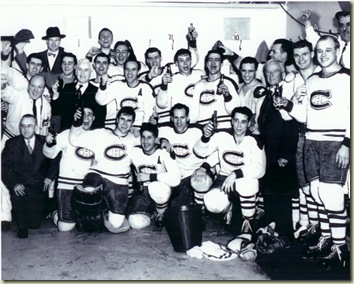
19-team-semi-51 The following season, the Canadiens were back in the finals, where Harvey was the victim of his own-goal in the game seven overtime against Detroit.

He didn’t let the error affect him though, as the following season he won the first of seven Norris Trophies as the NHL’s top defenceman.

“When I joined Montreal,” said Jean Beliveau, “He was the best defenceman I’d ever seen.”

As the Canadiens began their dynasty of five straight Stanley Cups, Harvey was the quarterback of one of the most dominating power play units in NHL history.

It was so effective that the NHL had to change the rules, in 1956, to allow a penalized player to return to the ice once the team with the man-advantage had scored.

Harvey had run of four Norris Trophy’s from 1955 to 1958. His defensive partner, Tom Johnson, would win it in 1959 before Harvey reclaimed it yet again the following season.

With the retirement of Maurice Richard after the 1959-60 season, Harvey was named captain of the Canadiens.

It would be a short tenure however. Despite being known as a good team leader on the ice and in the room (many felt he should have been named captain over the popular Richard), his relationship with management began to diminish.

image

Along with other players, Harvey had been attempting to form a players association when they learned that the owners were not matching the players pension contributions.

The attempt went without success and Harvey was essentially blacklisted, as he put it, by the league.

The rift between Harvey and Canadiens GM Frank Selke was further escalated by his alcoholism and bi-polar disorder.

Harvey was notorious for being the last player to get on the bus or on the train, according to assistant GM and former defenseman Ken Reardon.

He also appeared at a formal event in a Tuxedo and running shoes and once skipped a team dinner to go drinking.

“I’m my own man,” Harvey said. “This is who I am.”

Reardon and Selke felt otherwise and something had to be done.

“As a front office man, you don’t want him as captain,” Reardon said.

269

At the end of the 1960-61 season, after winning his sixth Norris and ninth First Team All Star selection, he was traded to the New York Rangers.

"It had to do with union activities," Harvey said on the trade. "I was a First Team All-Star and won the Norris that year. You don't give away a player like that!"

He has a valued point as Ted Lindsay, another involved in the players association attempt, was traded to the Chicago Blackhawks three years earlier.

“I would have been traded earlier,” Harvey once said. “But we kept winning all those Cups. Selke knew if he traded me then, the fans would riot.”

Harvey fought to stay in Montreal but realizing that he had no choice in the matter, reported to the Rangers.

As the last player-coach in NHL history, he won his final Norris trophy and First-team All-Star awards while leading the Rangers to their first playoff birth in three seasons.

He stepped down as coach to focus on playing with the Rangers for two more seasons.

“I liked playing best,” he said. “Being with the boys, having fun and tossing back a few after the game. I never really liked coaching that much.”

Left unprotected by the Rangers in the 1963 intra-league draft, he signed as a free agent with the AHL Quebec Aces. Harvey would play for Quebec, Baltimore and Pittsburgh over three seasons before resurfacing in the NHL, for two games in 1966-67, with Detroit.

With the NHL expanding to a dozen teams, Harvey became player-coach of the St. Louis Blues’ AHL affiliate in Kansas City.

doug-harvey

 one_harvey05

He would be called up by the Blues in their playoff run during the 1967-68 season, and played all 70 games for the Blues in the following year.

At age 44, he retired from playing.

Harvey stayed in hockey as an assistant manager for the WHA’s Houston Aeros. He is credited with convincing the Aeros to sign two underge brothers, Mark and Marty Howe, to pro contracts.

Once they were signed, their legendary father, Gordie Howe, came out of retirement to play with his sons.

The question of being black listed comes into play once again in 1972. With his credentials, Harvey should have been elected into the Hockey Hall of Fame that year, but he wasn’t.

It was the same year that Howe and Jean Beliveau were exempted from the three-year waiting period.

“They don’t want me in there because I’ve been known to hoist a few,” Harvey said never afraid to speak his mind. “And they’ve never forgiven Ted Lindsay and I for helping for the NHLPA. We were blackballed when we did that.”

For the record, Ted Lindsay was inducted into the Hall of Fame in 1966 and also was exempt from the three-year wait.

On July 5, 1973, the Hockey Hall of Fame sent a letter out to Harvey congratulating him upon his election to the Hockey Hall of Fame.

Fifteen days later, Harvey’s wife Ursula replied to inform the Hall of Fame that Harvey had refused to accept his election, despite talking to him over the phone the night before in hopes of changing his mind.

Instead of spending the day when a player has achieved a pinnacle of personal success, Harvey spent the day fishing and drinking.

During retirement, Harvey went into a nomadic lifestyle, travelling across the country.

Many believe he was homeless and living in a boxcar. Truth of the matter was, it was a mobile, and rather elaborate, unit once owned by John Diefenbaker for visiting dignitaries. Harvey’s home-base was set up on a raceway, just outside of Ottawa.

One of hockey’s greatest players had virtually vanished into obscurity.

In 1984, Harvey had stopped drinking. At the same time, on their 75th anniversary, fans of the Montreal Canadiens selected an all-time All-Star Team.
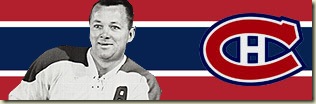
1habs_harvey_50082 Jacques Plante was chosen as goaltender, the forwards were Jean Beliveau, Dickie Moore and Maurice Richard while the blueliners selected were Larry Robinson and Doug Harvey.

The group, along with all-time coach Toe Blake and Aurele Joliat made a memorable appearance in uniform before the Forum crowd.

On October 26, 1985, his No. 2 was retired by the Canadiens and he was hired on as a part-time scout.

image

Harvey was diagnosed with cirrhosis of the liver in 1988 and died a week after his 65th birthday in Montreal General Hospital in 1989.

“I feel very,” said Maurice Richard on his passing. “We had a lot of fun together. Doug was great, always willing to help.”

"If I had to do it over again," Harvey said shortly before his death. "I wouldn't have changed a thing."

He truly was his own man.

3825787769_83c7b901fc

Did you know?:

dougharvey_1943

Doug Harvey began playing hockey as a goalie, but was moved to forward.

He was a multi sport athlete in high school and played hockey for the school throughout his years at the school, although somehow was excluded from the 1941 Senior team.

In 1942 he was moved from centre to defence by coach Jack Black, and in 1943 his school won the city championship.

He was touted by the Boston Braves to play baseball, and also had a chance to play pro football, before signing on with the Royal Canadian Navy, where he won the Navy boxing title.

Wednesday, December 2, 2009

Habs Twelve Days of Trivia Contest: Day 2

P1060001

It’s day two of my Twelve Days of Habs Trivia!

Each day, from December 1 to December 12, I will post a trivia question about the Montreal Canadiens.

Don’t worry, they won’t be too difficult.

Once all the questions are posted, send me an email with all twelve answers.

Entries must be received by December 14, 2009.

All correct entries will be placed in a hat, and the lucky winner drawn.

The Prize pack will consist of:

  • A DVD copy of the original series of “Peter Puck : How to Play the Game”
  • Five packs of cards from the Canadiens Upper Deck Centennial Set
  • A set of reusable Montreal Canadiens Stickers
  • A Montreal Canadiens bumper sticker
  • A die-cut indoor/outdoor magnet
  • A collection of four 1/64 Die-Cast Canadiens vehicles
  • An assortment of 50 Montreal Canadiens hockey cards with some nice surprises in them

The prize pack will have an approximate value of $50.00

Good Luck to all!

Here’s trivia question number two:

Multiple Choice: Doug Harvey won seven Norris Trophies with the Canadiens. In which of the seasons listed below did he not win it?

a.) 1957-58

b.) 1958-59

c.) 1959-60

d.) 1960-61

Saturday, November 28, 2009

November 28, 1925: Georges Vezina plays his last game

image

It was a typical sight, for fans of the Montreal Canadiens, to see Georges Vézina between the pipes for their team from it’s second season and into the early 1920’s.

After all, the Chicoutimi Cucumber had played in every NHA and NHL regular season game (328), and post-season game (39) since joining the Canadiens fifteen seasons prior.

But in November of 1925, that changed forever.

Vézina had reported to training camp, as usual, but felt ill after an exhibition game against the Victoria Cougars on November 18.

He lost nearly 35 pounds during training camp, and was running a fever of 102. Doctors diagnosed it as a flu virus, and recommended bed rest.

Vézina still made his start for the Canadiens home opener against the Pittsburgh Pirates on November 25.

The game began as usual, but during the the first period Vézina, was suffering from chest pains and left the ice at the end of the fist period bleeding from the mouth.

He reportedly collapsed in the Canadiens dressing room but returned to start the second period.

Vézina collapsed again on the Mount Royal Arena ice before the period began and, after a short delay, left the game.

He returned to the dressing room, sat in his corner and took off his pads for the last time.

image Alphonse LaCroix, a U.S. Olympic goalie, took to the ice to finish the game and claimed the win for the Canadiens. LaCroix played the next four games for the Canadiens, posting just one other win.

Vézina went home and saw his doctor, J-E Dube, the next day. The Canadiens iron-man was diagnosed with tuberculosis and told that his lungs were in dreadful condition.

Dr. Dube told Vézina that his chances for survival were slim and recommended that he go home to Chicoutimi to rest.

Vézina listened to his doctor’s orders, but first made a final visit to the Forum on December 3.

There, in the dressing room, he saw his equipment laid out in the corner, as it always was, by trainer Eddie Dufour.

Team manager Leo Dandurand noticed tears rolling down the goalie’s cheeks. Dandurand placed a hand on Vézina’s shoulder and asked, “Is there anything I can do for you, Georges?”

“Yes, Leo. I would like to go home now. And I would like to take my Montreal sweater with me, the won I wore in the Stanley Cup finals in ‘24.”

Dandurand tracked down the sweater and Vézina tearfully said good-bye to his teammates for the last time.

The Canadiens manager then made a statement to reporters.

“Georges is gone and I doubt if hockey will ever know his like again. He has been a great credit to professional sport. He was a great athlete and a wonderful gentleman.”

The Canadiens paid Vézina his full salary ($6,000) for the 1925-26 season, despite only playing part of the first game.

image

Vézina returned to his home in Chicoutimi and died on March 27, 1926 at age 39.

Close to 1,500 people crammed into the cathedral in Chicoutimi for his funeral and over 800 Catholic masses in Montreal and Chicoutimi were devoted to Vézina’s memory.

The Montreal Standard referred to him as the "greatest goaltender of the last two decades" in their obituary.

Later in the year, Dandurand and fellow Canadiens owners Louis Letourneau and Joe Cattarinich donated the Vézina Trophy to the NHL to honor their departed goaltender.

image

Georges Vézina Facts and Figures

  • Inaugural member of the Hockey Hall of Fame, elected in 1945.
  • Member of the Canadiens first two Stanley Cup winning teams (1916, 1924) and appeared in three other Cup finals.
  • Was the first goalie in the NHL to record a shutout on Feb 18,1918 and was the first goalie credited with a shutout.
  • Referred to as the "Chicoutimi Cucumber" for his cool demeanor on the ice.
  • He was also known as "L'Habitant silencieux" (the "silent Habitant"), a reference to his reserved personality. He often sat in a corner of the team's dressing room alone, smoking a pipe and reading the newspaper.
  • Contrary to urban legend, he never had 22 children. That came from a boastful story relayed to the media from Dandurand.
  • Vézina had two children, Jean-Jules born in 1912 and  Marcel Stanley, who was born the night the Canadiens won their first Cup.
  • His 328 consecutive games was a record that stood for over 30 years.
  • Gained the attention of the Canadiens when he led his amateur club to a shutout victory in an exhibition against the Canadiens.
  • Led in GAA seven times in his career and finished twice five times.
  • Played wearing a toque (which can be seen on the photo of him on the Vézina Trophy) and made use of his large stick for blocking shots. He also didn’t learn to skate until his late teens and started playing goal in his work boots.
  • Was known to play without gloves…ouch!
  • Ranked 75th in The Hockey News 100 All-time Greatest Players
  • The city of Chicoutimi renamed their hockey arena the Centre Georges-Vézina in 1965

image

Georges Vézina’s Career Stats

image

Sources for this article:

Books:

  • Jenish, D'Arcy (2008), The Montreal Canadiens: 100 Years of Glory, Doubleday Canada, ISBN 978-0-385-66324-3
  • McFarlane, Brian (2008), True Hockey Stories: The Habs, Prospero Books, ISBN 978-1-55267-714-8

Blogs/WWW:


Monday, November 9, 2009

In Case You Missed It: Habs News and Blogger Views for November 9

image The HHOF class of 2009 get their rings – Sun Media photo

It’s Hall of Fame Induction night so I’ll be planted in front of my TV, wrapped in a blanket while fighting off a bug.

Congratulations to all five inductees, Brett Hull, Lou Lamoriello, Brian Leetch, Luc Robitaille and Steve Yzerman.

Last night was the NHL Legends Game at the ACC. I was curious as to whether or not Mr. Hull would play. Over the summer, Hull told me he no longer puts on the skates. He was true to his word on Sunday night.

The Inductees received their rings in a ceremony on Monday morning and the official ceremony will air on TSN.

Wayne Gretzky, who played with all four player inductees in some capacity, will be in attendance. Commissioner Gary Bettman???? I’m hearing no.

The Montreal Gazette’s Red Fisher on this year’s class.

Ok on to what little Habs stuff we have: The team had an off-day in preparation for Tuesday’s game against Calgary, and most of us are still talking about Halk’s agent.

In light of the Halak agent fiasco, Chris Boyle offers a very deep statistical  analysis of the Canadiens goaltenders at Habs Eyes on the Prize.

CJAD analyst Murray Wilson was a guest on HockeyCentral, on the FAN590 and Rogers Sportsnet. Unfortunately, I can’t find Mr. Murray’s segment on the Fan’s on demand page.

Wilson talked of the above mentioned issue and the real problems facing the Canadiens, a depleted blue line and no second scoring.

Best Line: “Watching Marc-Andre Bergeron on the ice, it’s always an adventure. It’s like a beer league.”

The H Does Not Stand For Habs: Has an interesting look at the player-agent relationship.

Yves on Habs: Looks the Canadiens newest defensive acquisition, Jay Leach and the rest of the Habs D.

Guillaume Latendresse to Oilers trade rumours?: Apparently a deal with the Edmonton that would send Gui! and SK74 to oil country was mentioned on the Team990 Monday afternoon.

Laraque on IR?: CJAD’s Rick Moffat noted after Saturday’s loss that Georges Laraque was nowhere to be found on the team’s game sheet.

Whether he is on IR or long-term is still being questioned, but Eric Engels was following the situation earlier on Twitter.


Wednesday, November 4, 2009

Golly Gee Willikers! It’s Howie Meeker’s Birthday!

imageHowie Meeker is maybe best known to fans of my generation as the colorful analyst from Hockey Night in Canada.

Now, stop it right there!, as he would say, because there is so much more to this legend.

Born in Kitchener, ON in 1923, Meeker quickly rose as a prominent junior hockey star, in the OHA and JOHA, before going into military service during World War Two.

His hockey career, and life for that matter, could have ended right there when a grenade exploded between his legs.

The hockey gods were clearly looking down on Meeker, as he recovered from his wounds and went to play a season with Stratford of the SOHA in 1945-46.

image Meeker with the Maple Leafs – HHOF photo

The following season, he was signed as a free agent, by the Toronto Maple Leafs, in the spring of 1946.

Meeker tied the record for most goals in a game by a rookie when he scored five against Chicago in January of 1947.

image

His 45-point rookie season was good enough to earn him the Calder Trophy as Rookie of the Year. One of the runners-up was someone named Gordie Howe.

With the Leafs, Meeker spent most of his time playing on the "Tricky Trio" line with Ted Kennedy and Vic Lynn, and would play on four Stanley Cup winning teams (1947, 1948,1949, 1951). His NHL playing career continued with the Leafs until 1954.

It was interesting to learn that Meeker was also a Member of Parliament for a term (1951-53) while still playing with the Leafs.

image Meeker as an MP for Waterloo-South- HOC photo

Meeker was head coach of the Leafs for one season (1956-57) and had a dismal 21–34–15 record. He was became general manager in 1957, but was fired before the start of the 1957–58 season.

Still eager to play and teach the game, Meeker spent the next parts of twelve seasons playing part-time and coaching in Newfoundland.

It was in St. John’s where he got the broadcast bug. He started doing radio work as a sports announcer on CJON-AM in 1957, and named the station’s sports director the following year.

During the late sixties early seventies, Meeker began to run summer hockey camps all over North America.

His book “Howie Meeker’s Hockey Basics”, published in 1973, has been listed as  one of the 100 most important Canadian books by Literary Review of Canada in 2005.

image

In 1969, Meeker joined Hockey Night in Canada, as a colour analyst ,alongside the likes of Danny Gallivan and Dick Irvin.

His squeaky voice and use of the telestrator made him a standout as one of the top hockey analysts.

Intrigued by his instructional abilities and his passion to properly instruct younger players, the CBC ran a series of 15-minute episodes of Howie Meeker’s Hockey School. 107 episodes ran from 1973 to 1977.

Those clips can be found on the network’s digital archives.

After just five years with HNIC, Meeker won the Gordon Sinclair Award for Outspoken Opinions and Integrity in the Field of Broadcasting in 1974.

image Howie Meeker as a member of TSN’s broadcast team – HHOF photo

He also did work as an analyst for BCTV’s coverage of the Vancouver Canucks before joining TSN for even seasons from 1987-1998.

His value as an analyst could be more defined when he did work on four separate networks (CBC, TSN, NBC and BCTV) in one season. No other broadcaster has done that.

Meeker received the Foster Hewitt Memorial Award for excellence in hockey broadcasting in 1998 and was inducted into the Hockey Hall of Fame’s Broadcaster Category.

image Meeker in 2008 – Oceanside Media Club photo

In 1999, he published his biography, “Golly-Gee – It’s Me: The Howie Meeker Story”.

That same year, The Hockey News named their “100 Most Colorful People in Hockey”, where Meeker was ranked #76.

From his great one liners, to his passion for the game from an educating aspect, Howie Meeker has given back to hockey everything he has learned from the game.

Happy Birthday Mr. Meeker!

More information on Howie Meeker can be found on his website and the Legends of Hockey site.

An interesting two-part article, in the St. John’s Telegram by Meeker’s nephew Geoff, from this past spring on fighting in hockey: Part One and Part Two.


Saturday, October 31, 2009

Canadiens Halloween Birthday Greetings

October 31 is not just a night for trick-or-treaters, but also a birthday for a few Habs player both past and present.

image

A Happy 50th Birthday to former Canadiens great Mats Naslund.

The cup-winning winger, dubbed “The Little Viking”, ranks 11th in career points with 612 in 617 regular season games.

Naslund was also a member of the Canadiens 1985-86 Stanley Cup winning team and won the Lady Byng Trophy in 1987-88.

Already as star player in Sweden, before joining the Canadiens, he is in the International Ice Hockey Federation’s Hall of Fame.


image Former center Phil Goyette turns 76 years old.

Goyette played in seven seasons with Montreal (1956-63), playing on the last four of the Canadiens five straight Stanley Cup teams.

He played nine more seasons in the NHL, amassing 674 points in 941 games.


image

Current Canadiens center Tomas Plekanec turns 27.

Plekanec is having a great start to the 2009-10 season with 10 points in his first thirteen games.

Hopefully Pleky can celebrate tonight by lighting up the Maple Leafs!


and most importantly…

image Though no longer with us, one of the Montreal Canadiens first superstars was born on this day in 1887.

Edouard “Newsy” Lalonde  was a member of the Canadiens in their first season (1909-10) and scored 16 goals in just six games.

He would be a member of Montreal’s first Stanley Cup winning team (1915-16), and was captain on three occasions.

He was a player-coach for seven seasons (1915-22).

After retiring as a player in 1928, he returned to Montreal four years later as the team’s bench boss for two full seasons and part of a third.

Lalonde was elected to the Hockey Hall Of Fame in 1950.

Monday, October 26, 2009

Canadian Hockey pioneer honored with grave marker 79 years after his death

james_creightonJames Creighton (1850-1930) One of the pioneers of organized hockey in Canada

It took almost 80 years, but the gravesite of one of the game’s early pioneers finally has a marker at Ottawa’s Beechwood cemetery.

Canadian Prime Minister Stephen Harper presided over a ceremony, on Saturday, to unveil a grave marker and plaque to honor James Creighton.

image 

Prime Minister Harper (l)  and SIHR founder Bill Fitsell unveil the Crieghton gravestone at Beechwood Cemetery in Ottawa. Oct 24, 2009

Creighton was an avid sportsman who excelled in hockey, both as a player and an innovative organizer during the formative stages of the game.

He helped introduce the sport to Montreal in 1875 and captained teams in every recorded game there during the development years.

Creighton is credited with the organizing the first indoor hockey game,in 1875, at Montreal’s Victoria Skating Rink.

His hockey interest continued in Ottawa during a distinguished career as Law Clerk to the Senate between 1882 and 1930.

It seemed peculiar that a man of his accomplishment’s, and noted civil service, would be buried in Canada’s National Cemetery with an unmarked grave.

It was learned later that no proper gravestone was erected for him at Beechwood Cemetery because his wife passed away shortly after him and the couple had no children.

Thanks to the work of SIHR (The Society for International Hockey Research), a campaign was made to recognize one of hockey’s early pioneers.

Led by SIHR’s co-founder Bill Fitsell and a committee chaired by honorary president Edward Grenda, a plan of action was made in co-operation with the Beechwood Cemetery.

A fundraising campaign was set up on SIHR’s website and by August of 2009, sufficient funds were in place for the monument.

The biggest donors came in the form of Ottawa Senator’s owner Eugene Melnyk and Calgary Flames owner Harley Hotchkiss.

A Melnyk spokesman said the Senators owner saw a front-page story in the Ottawa Citizen and was surprised to learn that Creighton was buried in an unmarked plot at Beechwood.

Melnyk wanted "to ensure proper recognition for Mr. Creighton’s contribution to modern-day hockey,” the spokesman said.

With the funds in place it was arranged that Prime Minister Harper be invited to attend the ceremony.

The Prime Minister is a member of SIHR and is currently writing his own book on hockey history.

According to a spokesman for the PM, he began research on his book as leader of the opposition and still takes a few minutes out of his busy day to work on it.

The Prime Minister unveiled a plaque in Montreal’s Bell Centre (home of the Montreal Canadiens) in May of 2008 to honor Creighton.

image A plaque honoring Creighton’s accomplishments in hockey was also dedicated at the ceremony on Saturday.

“It was with great pride that I named Mr. Creighton as a Canadian of National Historic Significance last year and I am delighted to be here today,” the Prime Minister said.

“This monument marks another milestone in honoring the legacy of one of our country's pioneers. Canada needed a sport that would call to its winter soul. Before anyone else, Creighton heard that call and defined the game that from coast-to-coast transcends French and English, East and West; urban and rural and defines us as Canadians.

“Future generations of Canadian hockey fans who wish to pay homage to this founding father of our national sport will now be able to do so. Canadians will find him at rest in Canada’s national cemetery, surrounded by notables of Canadian political, military, economic and cultural history.”

The Prime Minister noted that Creighton remained even played hockey in the fledging Parliamentary League as part of the Rideau Hall Rebels.

image Prime Minister Stephen Harper, at the new gravestone for James Creighton.

“Creighton is responsible for ‘Canadianizing’ the game of hockey,” SIHR’s Bill Fitsell said, “by incorporating elements from sports such as field hockey, hurling, rugby and lacrosse into the game.

He was key to getting the game underway.”

SIHR still wishes to take the work of Mr. Creighton to another level, as an honored member in the Builder’s category of the Hockey Hall of Fame.

"He played a significant role and it's rather unfortunate, and somewhat inappropriate, that he has been ignored in that fashion," Edward Grenda said.

“The hall has yet to acknowledge the pair's nomination of Creighton,” Fitsell said.

“Hopefully,this event will spur that recognition of the hockey pioneer.”

__________________________________________________________

For his contribution to the project, Mr. Melnyk was acknowledged on the plaque. By the time Mr. Hotchkiss’ donation arrived, the plaque was already in production. A new plaque bearing Mr. Hotchkiss as a major contributor will be made and replace the currrent one.

More on the Society for International Hockey Research can be found on their website.

Author D’Arcy Jenish’s article on Mr. Creighton and the grave marker project from the January 2008 Legion Magazine


Wednesday, October 21, 2009

New Jacques Plante biography: A must read for all hockey fans

plante_bookcover

Fifty years after he changed the world of hockey, a complete biography of hockey’s most important goalie is set to be released.

Jacques Plante: The Man Who Changed the Face of Hockey, gives a complete look into the life of one of the greatest men to stand between the pipes.

in his first book, author Todd Denault left no stone unturned in his research to give us insight into Plante’s life, from a prodigy teenaged player to the pinnacle of greatness in the NHL and well beyond.

Mr. Denault, a freelance writer and member of SIHR (The Society for International Hockey Research), realized that outside of a book Plante co-authored in 1971, that there was no full-scale biography on the Hall of Famer.

Denault spent countless hours researching books, interviews and newspaper articles devoted to the hockey legend. He also spoke to over forty individuals (a virtual whose who of teammates, coaches and journalists) who played with, or against him, coached or documented his career and game up with a fascinating biography.

Most of Plante’s story is publically known for his time and experiences with the Montreal Canadiens, but Mr. Denault captures his entire life in true essence.

From his first goalie stick, carved out of a branch by his father, to his first retirement from the NHL, his return to play with St. Louis, Toronto, Boston and Edmonton (WHA), and final retirement at age 46, the author covered all aspects.

While Plante’s worldwide claim to fame is donning a mask on a regular basis, after that famed day on November 1, 1959, the reader also learns of the legends other noted contributions that revolutionized the game and how the role of a goaltender has evolved.

Mr. Denault even looks into Plante’s post-playing career where he again changed the game as the first goaltending coach in the NHL with the Philadelphia Flyers and later returning to Montreal.

The book is a must read for any hockey fan (not just Canadiens fans) and the Mr. Denault is to be commended on bringing it to light.

Jacques Plante: The Man Who Changed the Face of Hockey will be available at all major books retailers (conventional and online), in both French and English, on October 27.

Online ordering info, and more information, can be found on the publisher  McLelland and Stewart’s website.

Other Book and related links:

Official Facebook page

Habs Eyes on the Prize’s interview with the author

SIHR (The Society for International Hockey Research)

Habs World (where Mr. Denault is a frequent contributor)

Hockey Book Reviews - hockey book reviews and interviews.


Monday, October 5, 2009

Happy Birthday St. Patrick!

patrick_roy_2 “I can't really hear what Jeremy (Roenick) says, because I've got my two Stanley Cup rings plugged my ears.” – Patrick Roy

A Happy 44th Birthday to arguably one of the greatest goaltenders in NHL history.

Patrick Roy was born on this day in 1965.

A fan of the rival Quebec Nordiques, Roy was drafted in the 3rd round (51st overall) by the rival Montreal Canadiens.

On February 23, 1985, he made his NHL debut when he replaced the Canadiens starting goaltender Doug Soetaert in the third period, and getting his first of 551 career NHL wins.

43253

After two Conn Smythe winning campaigns leading the Canadiens to Stanley Cup victories in 1986 and 1993.

Roy was an icon in Montreal, winning three Vezina Trophies and four Jennings Trophies in le bleu-blanc et rouge. He was named to three First All-Star and two Second All-Star Teams with the Canadiens.

0roy

After the infamous “Le Trade” of 1995, Roy won two more Stanley Cups with his new team, the Colorado Avalanche in 1996 and 2001 taking another Smythe trophy that year.

Patrick Roy retired in 2003, and  was inducted into the Hockey Hall of Fame in 2006.

Patrick “came home” when the  Montreal Canadiens retired his #33 on November 22, 2008.

roy1

roy2 At the news conference announcing Roy's jersey retirement, Roy stated that it was time for him to move on in regards to what happened in 1995, and that he hoped the Canadiens would do the same.

Obviously, they have.

More on Patrick Roy’s career can be found on the Legends of Hockey and on the Canadiens “Our History” site.


Saturday, October 3, 2009

Which Montreal Canadiens number should be the next to be retired?

Fifteen members of the Montreal Canadiens have been honored by having their jersey numbers retired.

The Canadiens acknowledged all of their Hall of Fame players last season by constructing the Ring of Honor around the Bell Centre.

But As the club continues it centennial celebrations, is there room in the Bell Centre rafters for a few more names to hang in the upper echelon?

Here are a few suggestions. I’ve added a link on the players names (below the photo) to the Canadiens “Our History” site profiles.

Before you ask, Saku Koivu is still an active player, so he was excluded from the list.

but_xz_241008 #3 Emile “Butch” Bouchard

Bouchard played fifteen years (eight as captain) and won four Stanley Cups along the way.

Known for his solid checking and his excellent ability to clear the puck to his forwards, Bouchard was elected to the Hockey Hall of Fame 1966.

Toe_Blake #6 Hector “Toe” Blake

Though he has 500 wins as a coach with the Canadiens and nine Stanley Cups, Hector “Toe” Blake was one of the greatest players of his era.

He led the NHL in scoring in the 1938-39 season and won the Hart Trophy as league MVP.

With just two penalty minutes in the 1945-46 season, Blake took the Lady Byng Trophy.

He played on the famous “Punch Line” with Maurice Richard and Elmer Lach, and scoredat least 20 goals a season with his linemates.

In thirteen season as a player, Blake won two Stanley Cups and scored 527 points in 569 games.

He was elected to the Hall of Fame in 1966.

Blake is already honored in the Canadiens Ring of Honor as well as their Builders’ Row.

elmer #16 Elmer Lach

A fourteen year member of the Canadiens.

His 26 goals and 54 assists won the NHL scoring title and Hart Trophy in 1944-45, the same year Richard scored 50 goals in 50 games.

Lach won his second NHL scoring title, receiving the inaugural Art Ross Trophy, in 1947-48.

With three Stanley Cups to his name, he was inducted into the HHOF in 1966.

It’s an outside shot to see #16 retired a second time as Henri Richard’s jersey has already been put to the rafters.

As the oldest living Canadiens Hall of Famer (91, Bouchard is 90) it would be a nice gesture.

shutt1 #22 Steve Shutt

Inducted into the HHOF in 1993, Steve Shutt’s 408 goals with the Canadiens rank him first for left wingers and fifth in team history.

Shutt is only one of two players to record 60 goals in a season and his nine straight 30 goal seasons remains a franchise record.

He ranks eighth all-time in Canadiens scoring (776 points) and won five Stanley Cups in his thirteen years in Montreal.

pin_lemaire01 #25 Jacques Lemaire

In twelve seasons with the Montreal Canadiens, “Coco” never had a season with less than 20 goals and was an exceptional defensive forward as well.

He ranks in the top ten in franchise scoring with 366 goals (7th), 469 assists (5th) and 835 points (7th).

His 139 points in the playoffs place him second to Jean Beliveau.

Lemaire won eight Stanley Cups with the Canadiens and joined the HHOF in 1984.

mats-naslund #26 Mats Naslund

“Le Petit Viking” only played in eight seasons with the Canadiens, but made the most of it.

He is the last player to record 100 points for the Canadiens and had 612 points (11th all-time) in 617 games with the bleu-blanc et rouge.

Naslund was a member of the 1985-86 Stanley Cup winning team, and took the Lady Byng Trophy in 1987-88.

His five assists in the 1988 All-Star Game is a league record.

Naslund would be an extreme long shot, being he only player in this list that is not in the Hockey Hall of Fame.

If you have any other worthy suggestions, email me or leave a comment. I will add a profile to the player you suggest.