Showing posts with label Howie Morenz. Show all posts

Friday, June 4, 2010

Basement find pulls vintage Morenz and Joliat cards!

image

It’s one of those typical stories of finding a lost treasure in an attic. This one came to my attention thanks to a small writeup, by Len Corben, in the North Shore Outlook.

A North Vancouver resident recently uncovered a box of hockey cards, from the 1930’s, in his/her basement. Though not in mint condition (there was evidence of them once being glued and trimmed), the unnamed person brought them to the Greater Vancouver Sports Memorabilia show to get some input.

One of the show exhibitors, renowned sports memorabilia auction house Classic Auctions had a chance to look at them. The cards were part of the 1933-34 O-Pee-Chee Hockey and World Wide Gum (WWG) Ice Kings sets.

Two notable cards from the WWG set (also known as V357 in the collector world) include the great Howie Morenz and Aurel Joliat. Another Joliat card graces the O-Pee-Chee (V304) cards.

Individually, the cards of the two Habs greats have book values of anywhere from $500 to $2000 dollars each in ExMt condition. Given the condition of the cards in the descriptions, they are probably valued at 15 to 40 percent of that. But at auction all that can change.

The group of 46 cards is now part of Classic’s Historical Hockey Memorabilia Auction, which is highlighted by Paul Henderson’s game-winning jersey from the 1972 Summit Series. The lot of cards is currently selling at $400 and bidding ends on June 22.

Over the next couple weeks, I’ll be posting more links to Habs-related lots of interest at this auction.


Thursday, March 11, 2010

March 11, 1937: Morenz Mourned by Fans and NHL alike

one_morenz06 Fans, family and teammates fill the Montreal Forum to attend the funeral for Howie Morenz 3/11/1937 – HHOF photo

On March 8, 1937 the hockey world lost Howie Morenz.

Deemed “The Babe Ruth of hockey”, the Montreal Canadiens star suffered a broken leg after a collision with Earl Seibert on January 28. Confined to a hospital room, “The Stratford Streak” would never recover from the devastating blow.

Having numerous complications from the injury, Morenz had his up and down days. One day would find the 34-year-old optimistic that he would return, and then thinking his career was over the next. It was diagnosed that suffered a nervous breakdown at St. Luke’s Hospital on March 5.

Despite a successful examination just hours earlier, a coronary embolism, caused by blood clots in his leg, finally caught up with him that Monday morning in March. Longtime line mate and friend Aurel Joliat said he died of a broken heart, and was probably right.

The hockey world was stunned by his loss as word made way across Canada and into the United States. Tributes poured in from former opponents and officials from the NHL.

“He had a heart that was unsurpassed in athletic history and no one ever came close to him in the colour department. After you watched Howie you wanted to see him often, and as much as I liked to play hockey, I often thought I would have counted it a full evening had I been able to sit in the stands and watch the Morenz maneuvers. Such an inclination never occurred to me about other stars.”

- Eddie Shore

“It is a terrible loss to the game, and a terrible loss to the Canadiens themselves. I certainly sorry for his family, for Howie thought a lot of his young boy, who will sorely miss him.”

- Conn Smythe

“He was one of the all-time greats of the game and it was only for the good of the game that the Rangers let him return to the Canadiens he loved so well.”

-Lester Patrick

The funeral would be held at the Montreal Forum on March 11 at 2:30 p.m. Morenz’s casket would arrive hours earlier and was placed on a bier adorned with wreaths, flowers and crosses.

Friends, fans and family made their way past the bier to pay respects to the fallen hero. Young, old, rich or poor, the number was estimated as high as 50,000 people.

InductFact7 Longtime teammate Aurel Joliat looks at Morenz’s vacant stall – HHOF photo

The assortment of flower arrangements was extensive, 150 in total. There were several No. 7 floral arrangements, but the one that stuck out the most was made of of lilies and roses with a card that read, “To Howie from Aurel.”

One of two hockey stick shaped floral arrangements came from “The boys in the balcony at the Boston Garden”, fans who jeered him yet cheered for him on the inside.

His No. 7 jersey, skates and his last stick he played, covered in a wreath, were laid alongside the casket.

Clasped in Morenz’s hands was a bunch of roses, placed there by his widow Mary Morenz, with a note from this three children, “To Our Daddy”.

The pier was placed at center ice, where one Forum usher stated, “Right under the coffin, there’s the blue circle where Howie faced the puck. He’s back again in his old position.”

Honour guards consisting of his Canadiens teammates and friends would rotate every half hour leading up to the service.

The first true superstar of the NHL, Morenz always filled the stands in Montreal and anywhere else he played. Even in death he could do the same, as well as filling rows of chairs on the wood covered Forum ice while close to 15,000 people waited outside.

imageThe Morenz family filled the first rows of seats and were followed by not just the players and staff of the Montreal Canadiens, but also the Montreal Maroons and Toronto Maple Leafs.

The NHL came in full representation, led by president Frank Calder. Owners and GMs from all teams and numerous referees were all in attendance. Former Canadiens owner Leo Dandurand made the trek from Louisiana.

The funeral was broadcast on Montreal radio station CFCF and had a simple format consistin of a prayer and hymn. Presbyterian minister Rev. Dr. Malcolm Campbell presided over the ceremony, delivering a brief eulogy.

“He was a hero in the true sense of the word. He never knew what is was to quit. Howie Morenz was not only the idol of thousands upon thousands of fans who went to see him weekly play hockey, but he was above all the hero of his teammates. It was his spirit that appealed to every player to do his best.

He chose hockey as a profession and he made an unqualified success of it. He was the fastest skater, I am told, in the business, a star, a superstar, a star on the ice and a star off the ice. He came into the dressing room whistling and singing, the cheering spirit of all his teammates. Everyone loved him, opponents as well as supporters. It is commonplace to say that no single player ever won such publicity as did Howie Morenz and yet it left him the same gentle, unassuming, plain man.”

- Reverend Dr. Malcom Campbell

Six of Morenz’s teammates (Babe Seibert, George Brown, Armand Mondou, Georges Mantha, Paul Haynes and Pit Lepine) would be pallbearers and carry the coffin out of the Forum, where thousands waited to catch a final glimpse before the motorcade made it’s way to Mount Royal Cemetery for burial.

20775_118497353227 Howie Morenz’s grave marker in Mount Royal Cemetery – findagrave.com photo

In a time before television, there is little video footage of the funeral, but the CBC archives has this brief clip.


Sunday, November 8, 2009

Habs Fan Makes a Vintage 1930’s Find

100_4149

A Canadiens fan’s family member unearths a great piece of history.


A team photo of the 1936-37 Montreal Canadiens.


Bottom row (from l to r): Armand Mondou, Paul Haynes, Georges Mantha, Joffre Desilets, Pt Lépine, Wilf Cude, Johnny Gagnon, Howie Morenz, Aurèle Joliat, Paul Drouin, Rod Lorrain.

Top row (l to r): Jim McKenna (Trainer), Roger Jenkins, Albert “Babe Siebert”, Jack McGill, Toe Blake, Cliff Goupille, Cecil Hart (Coach/GM), Ernest Savard (President/Owner), Jules Dugal (secretary), Bill Miller, George Brown, Paul Runge, Walter Buswell, John Laurin )Assistant trainer)


I recently received an interesting email, last week,from one of my readers named Heather.


Her grandfather had a team picture of the Montreal Canadiens from what he thought was around 1939. The photo was also autographed by goaltender Wilf Cude.


Inquiring if I might have any knowledge of it’s value, she forwarded a scan of the photo.


After uploading the photo, I easily realized that her grandfather was off in the date of the photo, but in a very good way.


The team photo was actually one of the 1936-37 Montreal Canadiens, and one of significant importance.


After a dismal 1935-36 season, the Canadiens had acquired Albert “Babe” Siebert as their captain and brought back coach Cecil Hart.


Hart only agreed to return to Montreal on condition that Canadiens legend Howie Morenz would be brought back as well.


Hart’s wish was granted, and Morenz would have one final fatal season with the Canadiens.


Morenz’s tragic story is legendary after a collision with Chicago’s  Earl Siebert in January of 1937.


Morenz suffered a leg fracture and on March 8th, blood clots resulting from the injury would eventually stop his heart, taking the life of one the NHL’s first superstars.


With the loss of Morenz, the Canadiens, led by Babe Siebert’s MVP season, struggled in the remaining games yet still won their division. They would lose in the semi-finals to the Detroit Red Wings.


The photo belonging to Heather’s grandfather is thus the last team issue to feature Morenz.


The photo is also significant as it is the first Canadiens team photo with a young Toe Blake standing in the back row.


Blake had played in 11 games for the Canadiens in 1935-36, after being acquired late in the season from the Montreal Maroons, and was not in that year’s photo.


While the condition of what appears to be an original photo is in a lower grade condition, the historical value is great in it’s own sense.


I referred Heather to some noted collector site’s for a professional evaluation and appraisal.


100_4158 The personalized Cude autograph looks very authentic to other specimens I have looked at, with some ink faded on the C.


If you have any other appraisal information on this photo, please email me and I will forward it on.


image Wilf Cude in the late ‘30s with the Canadiens


Notes on Wilf Cude:


  • Began his career in the NHL with the Philadelphia Quakers in their only season (1930-31).


  • Was acquired for cash by the Canadiens from the Quakers and was the NHL’s spare goaltender for Chicago and Boston before seeing some full-time work while on loan to the Detroit Red Wings.


  • Recorded a shutout in his first game as a Canadien.


  • Despite a 11-26-10 record in 1935-36, he recorded six shutouts.


  • Second-Team All-Star in 1936 and 1937


  • One of the smallest goalies (5’9”) and listed at 130 to 135 lbs.


  • Born in Wales and learned to play hockey In Winnipeg.


  • A member of the Manitoba Hockey Hall of Fame


A special thanks to Carl Lavigne, the Canadiens Manager of History and Archives, for getting me the names to tag the team photo.

Monday, November 2, 2009

November will set the tone for the Canadiens

image

Mike Cammalleri is featured on the Canadiens’ online calendar, available here.

The Montreal Canadiens managed to squeak out of October with a 7-7 record.

Granted the team was without Andrei Markov for the month less a portion of their first game, but let’s look at a few individuals and some statistical tidbits.

First some positives:

The home ice of the Bell Centre appears to have been the comfort zone for the les bleu-blanc et rouge, going 5-2.

They were 3-1 against division opponents, though two wins against the Leafs went into overtime/shootout and shouldn’t have.

In one-goal games, they went 6-4 and 6-0 past regulation.

Newcomers Scott Gomez, Mike Cammalleri and Brian Gionta are, thus far, a big improvement over the departed Saku Koivu, Alex Tanguay and Alex Kovalev.

Travis Moen and Paul Mara are playing much better than expected.

Jaroslav Spacek and Roman Hamrlik have banked the big minutes on the blue line in the absence of Markov. Shots-per-game against are slowly getting more respectable, but still just under 30-per-game.

Now the not so good:

When their opponents scored four goals or more, Montreal was 2-3. Two of those games were severe beatings by serious playoff contenders (Vancouver and Pittsburgh).

In goals decided by one goal or more, the Habs sported a 1-3 record with only win coming from a 5-1 drubbing of the lowly Islanders

The Canadiens have 36 goals in their 14 games, 20th in the league, averaging 2.57 per game. 21 goals came in seven home games and 15 in the seven road games.

Factor out the 5 goal night against the Islanders, and the home-game average is more realistic.

The power play ranks 25th in the league at a disappointing 15.1%.

The Canadiens are tied for second in the league with 75 minutes in minor penalties, and their penalty kill ranks 24th,at 75.8%, with one shorthanded goal.

Their ability to comeback when trailing a game is just 2-4 when trailing after 20 minutes and 0-5 when behind after two periods.

Do I need to even talk about the brothers Kostitsyn? The younger ones actions speak words for him and as for the older one, just listen to the audio from Monday’s practice via HabsInsideOut.com

Guillaume Latendresse cannot find his opportunity to be the power forward that he is expected to be, and Hal Gill is quickly becoming the weak link on the blue line in the fans eyes.

The real concern seemed to be commitment to 60 minutes of play. Several games were the result of the team losing focus for a period, and the opposition took advantage of it.

Coach Jacques Martin has been emphatic through the season the the team is still looking for an identity and that has to be expected with the roster moves made in the off-season.

November should give us that identity with a dozen games (seven at home) as to whether the Canadiens can be a real playoff team or squeeze into a final spot in the last game, or two.

The Canadiens will face their rival Boston, for the first time this season, and a rematch against Calgary in the first four games of the month.

The last two weeks could be of real interest when the Canadiens have a pair of games against the Washington (Ovechkin injury pending) and games against the Detroit,  Columbus and Pittsburgh sandwiched in between.

Today in Habs History: Howie Morenz’s No. 7 was retired, posthumously, on this day in 1937. He was the first Canadiens player to have his jersey number retired.

image An image from the Howie Morenz benefit game, 11/02/1937

On the same night, members of the Canadiens teamed up with the Montreal Maroons in a benefit game against all-stars from the rest of the NHL.

image Subban comfortable in the AHL: Canadiens prospect P.K. Subban tells NHL.com that he is comfortable in the AHL


Saturday, August 29, 2009

Aurele Joliat: A small forward with a huge heart to play.

Joliat_Aurele_01 Aurèle Joliat would be 108 years old today.

Fans of the Montreal Canadiens scratched their heads when they traded an aging star in Newsy Lalonde to Saskatoon for the rights to a 5’7” 136 lb winger in 1922.

They wouldn’t be scratching their heads long. In his rookie season (1922-23), the Ottawa-born Joliat scored 21 points in 24 games .

The following season, he was put on a line with Billy Boucher and a rookie centre named Howie Morenz. The The trio would lead the Canadiens to a Stanley Cup that season. It would be the first of three for Joliat in his sixteen year career with Montreal.

He led the NHL in scoring with 30 goals in 25 games in 1924-25 and in the 1933-34 season, Joliat would win the Hart Trophy as league MVP. He was a first-team all-star once, and a second-team all-star three times.

175px-Aurel_Joliat Joliat could score, check and his speed allowed him to avoid the big checks. But when he was hit, he could take them like a 200 pound man.

Over time he earned the respect of many of the toughest players in the league due to his resiliency in on-ice confrontations.

The small black cap Joliat wore during games, to cover a bald spot, reminded players of his willingness to retaliate.

Taunting him by knocking his hat to the ice always brought a swift reaction. Joliat would either score, or whack an opponent across the ankles. Suffice to say, the cap stayed didn’t get knocked off often.

“To knock off his black cap was to start a battle,” noted Hall-of-Fame sportswriter Elmer Ferguson.

“It drove Joliat into a hysterical frenzy, from which he lashed out blindly with fists or stick, and he didn’t pick his opponents.”

He had his share of injuries(six shoulder separations, three broken ribs, and five nose fractures), but it seldom kept him off the ice for long.

aj_mug One of his greatest rivals on the ice was Bruins legend Eddie Shore, a player who Joliat deemed as the meanest and toughest player that he’d ever met.

In one game at the Forum, Shore clobbered the diminutive Joliat and separated his shoulder. After being led off the ice, he was quickly back on and caught his rival on a rush.

“I leaped over the boards and intercepted the big bugger. Hit him with a flyin' tackle,” he said. “Hit him so hard he was out cold on the ice. He had it comin' I'd say . . ."

After the tragic death of Morenz in March of 1937, Joliat was never the same, and it showed on the ice.

InductFact7 Aurele Joliat mourns the loss of teammate Howie Morenz

He would play his final game a year later, when a shoulder injury caused him to miss the balance of the regular season and the playoffs.

Joliat would retire after the season was over, although he later claimed the Canadiens let him go after the Montreal Maroons folded.

His 270 goals were a team record that only be surpassed by Maurice Richard.

He would be inducted into the Hockey Hall of Fame in 1945.

In 1984, at age 83, he was honored by the Canadiens as an honorary member of their 75th Anniversary Dream Team.

dream I’ve included the footage from his appearance at the Forum. He’d have a few slips on the ice and carpet that Joliat would attest to an old rival.

“The ghost of Eddie Shore must have put that damn rug in front of me.”

Aurèle Joliat passed away on June 2, 1986. The man who played in the Canadiens first game in the Montreal Forum was gone.

Elmer Ferguson tried to answer how such a small player had outlasted every player that was in the NHL when he started.

“The source from which he gets his strength, and the virility to play robust games, to out-drive sturdier opponents at golf, to outwit them at hockey, to carry on the testing, wracking game over a span of years far beyond average-that’s a mystery. Try and Solve it, I gave up long ago.”

Other Facts and stories on Aurèle Joliat

Just how tough was he? Joliat apparently fell off a roof as a teenager, 35 feet to the ground, and landed on his back, narrowly escaping any serious injuries.

He was going to be a kicker with the Ottawa Rough Riders (CFL), but a broken leg kept him from playing. He then focused on hockey.

Habs Eyes on the Prize offers a must-read story on Joliat from his pre-Canadiens Days.

Dennis Kane dug up this poem on Joliat.

The Hockey News ranked Joliat #65 in their list of 100 Greatest Hockey Players

From the Canadiens history site. A story on his 250th goal.


Saturday, August 1, 2009

A conversation with L’Artiste of the Montreal Canadiens

cmMAJ Fortier LNH 08 191 Marc-André Fortier (right of statue) unveils his bronze tribute to HOFer Guy Lafleur (left of statue) at the Canadiens Centennial Plaza opening Dec 4, 2008

“L’Artiste”, Alex Kovalev may be gone from the Bell Centre, but the work of the true artist of the Canadiens, Marc-André J Fortier will stand proudly outside in the Canadiens Centennial Plaza for all-time.

Mr. Fortier, a world renowned Quebec painter and sculptor, was commissioned by the Canadiens to create the larger than life bronze renditions of Guy Lafleur, Howie Morenz, Maurice Richard and Jean Béliveau that currently stand amongst the Plaza.

I had the chance to speak to Mr. Fortier this week on his work, focusing on how he was approached to do this cumbersome project, the process involved to create these masterpieces and the end response.

My full length interview (21 min long) is available here.

The Canadiens V.P. of Marketing, Ray Lalonde, took on the Centennial Plaza project and after a foundry was determined to cast the statues (L’Atélier de Bronze), they provided Lalonde with six local area artists.

An artist for 23 years, 15 as a sculptor, the self-taught Fortier was interviewed by the Canadiens and then chosen to take on the task in February 2008 with a completion date of December 4 of that year.

Mr. Fortier told me that when the Mr. Lalonde and Canadiens took on the Centennial Plaza project, they travelled to other sporting arenas to study their teams bronze statues.

“They wanted something better,” Lalonde told Fortier.

“You gotta catch all the details.”

The Canadiens like to have the best to exemplify their greatest stars and told Fortier that they wanted something better than what other teams had produced for theirs.

IMG_2209

Marc-Andre Fortier in his studio working on Guy Lafleur.

Fortier would have an eight month window to complete the forms, and get them to the foundry in time to have them ready for the opening.

Four sculptures in eight months.

Lalonde gave Fortier Carte Blanche, providing him with any requirements, photographs, etc. needed to complete the project and also allowing him to make his own creative decisions.

The relationship between Fortier and Lalonde was a perfect business combination.

“He took everything on his shoulders, he trusted me,” Fortier said.

Lalonde also had he task to keep the curious eyes of the team’s management, such as owner George Gillette and club president Pierre Boivin, out of sight of the project to allow Fortier to focus and take the project in his own creative way.

He did receive one Canadiens’ visitor to his studio, as he worked through the summer, in the form of Hall of Fame defenceman Guy Lapointe.

Lapointe happened to be in the shop next store and the shop owner told him there was something in Fortier’s studio that he might like.

“When he saw Guy Lafleur, he said ‘When I played on the ice with him, I’d see exactly like that.’,” Fortier said, surprised to hear the voice of the Hall of Famer from behind him in the studio.

Fortier spent the first three weeks researching the project and had to rely primarily on photos of the four players provided to him by the Canadiens.

With many of the photos rather dated, most notably those of Morenz, he decided he needed to make the trip to Hockey Hall of Fame in Toronto. There he was able to access the Hall and it’s archives.

He focused for hours at the Hall on the equipment, jerseys and most notably the sticks (the only Morenz stick known is in the HHOF), taking measurements to assure every thing was to scale and accounted for.

From the number of lace holes in a skate to the stitching on the jerseys, no detail would be missed.

His passion for his work and detail would parallel that of the subjects he was studying when they skated on the ice.

With the researching under his belt, the work could begin.

Fortier’s friend and neighbor Richard May, documented the artist’s work in photographs from the studio to the foundry.

To let the Canadiens know he envisioned the project, Fortier sent two-foot models, called maquettes, of each the works to Lalonde to give the Canadiens an idea of his direction on the project.

marc-andre-fortier-bronze-sculptor-canadiens-hockey-754352

Marc-Andre Fortier works on a two-foot maquette of Rocket Richard

He told me that a very small edition of the two feet original four maquettes of the Centennial Plaza will be made in bronze, and will be sold to just a few lucky ones.

Fortier did acknowledge that he made some creative. enhancements to the players appearances to bring them more mainstream.

Making the clothing on Morenz look “more cool” as Fortier termed it, the sculptor figures the “Stratford Streak’s” uniform is about 85% to what it originally was.

With Lafleur, he made the shoulders slightly wider and the heads on all all the players were made a touch bigger to show the detail of the emotion of the subject.

“I wanted to have intensity in the eyes and in the thoughts and the concentration,” he said.

Because the statues were on five-foot pedestals, it was important for Fortier to get the players’ emotional passion across for visitors looking at them from the ground up.

Lalonde would check in periodically to review the work and discuss any minor details that were of any concern. There were very few of those.

Working solo from 5:30 in the morning until 11:30 at night six days a week, even some 24 hour days, the then 47-year old had a month and a half to work on each project before he would dismantle the completed clay/styrofoam formations and take them on a 2 1/2 hour trek to the L’Atélier de Bronze foundry in Inverness, QC.

maurice-richard-canadiens-hockey-bronze-fortier-707530 Fortier in his studio on the Howie Morenz model. The stick and gloves on the wall were used as reference points for the statues.

After some final tweaks by Fortier upon delivery to the foundry, the forms were in the hands of the foundry, a mold was created, they would be cast in 3/4” bronze plating.

065_65 Assemblage-01 103_103 marc-andre-fortier-studio-bronze-sculptures-hockey-montreal-720583

Above four photos from the bronze casting process of Mr. Fortier’s work at L’Atélier de Bronze foundry in Inverness, QC

The statues finally found themselves mounted to polished granite bases, each with a plaque detailing the player, to be unveiled on December 4th.

Fortier was all smiles at the unveiling.

“I don’t even care if they like it, I was on cloud nine,” he said.
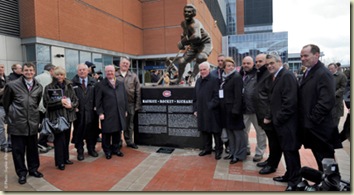
Maj_fortier_canadiens2 Fortier was on hand for the Plaza opening along with Boivin, Gillette, Lalonde, both living honorees Jean Béliveau and Guy Lafleur, as well as the families of Maurice Richard (including brother Henri) and Howie Morenz to see the original works revealed.

The reaction of the families and honorees was nothing more than thrilling.

Maj_fortier_Beliveau Maj_fortier_Morenz

Maj_fortier_Richard Maj_fortier_Lafleur

In an article by Dave Stubbs of the Montreal Gazette, Jean Beliveau had said, “I'm very honoured and happy, personally,….I had heard about the statues, but I never thought they were so big." and was followed by Lafleur who said, “..I think the sculptor did a hell of a job. When I began my career, I never expected this."

Stubbs concurred citing, “Gifted Quebec Artist Marc André Fortier has nailed all Four."

If there was any doubt of any further media concerns, long time Canadiens journalist Red Fisher summed it up by saying, “..those unveiled on Thursday were nothing less than slam dunks.”

“That was a good compliment,’ Fortier said.

Maj_fortier_canadiens1

In an another article by the Outlet Journal, Fortier had recounted how Morenz’s daughter Marlene Geoffrion told him that he had captured her father just the way she remembered him

Fortier also said in our conversation that Morenz was the most difficult to capture so his daughter’s words were extremely appreciative.

Although Howie Morenz Jr., was unable to attend the opening, Fortier did get word that he did make his way to Montreal.

Dave Stubbs later wrote of the younger Morenz’s visit to the Bell Centre the following spring and emailed a photo, telling Fortier on how pleased Morenz, Jr. was with the job he had done.

“I had a fantastic opportunity,” Fortier said.

“I tried to to do my best and I am very very happy I had a chance to do that. It’s something that’s going to be seen my a million people a year.”

Mr. Fortier’s other works can be seen on his website.

Photographs in this article were used by permission of Mr. Fortier.

Photography Credits: Richard May (Foundry and Studio), Sophie D’Ayron (Centennial Plaza opening)

Saturday, July 4, 2009

The Hockey Hall of Fame, Part One: A must visit for Canadiens Fans!

P1050301 I recently had some time in Toronto to play tourist and explore the Hockey Hall of Fame.

For the record, the last time I paid a visit to the Hall was nearly 20 years ago in it’s old diminutive home at the Exhibition grounds.

Now situated in the old Bank of Montreal Building on the northwest corner of Front and Yonge, the Hall has a massive 57,000 square foot facility to display hockey’s history.

Upon entering the foyer to the Hall through the lower level of the building, one finds a large goalie mask display known as the Mask Columns.

P1050096 Encased in the columns are Ken Dryden’s pretzel mask and two masks that he used later in his career. It also shows how one of these fiberglass mask was made.

P1050098 Behind the columns is a wall showcasing 1300 pucks acquired at different arenas and tournaments around the world.

After paying my $15 admission, that was worth every penny, one of the first things you see are nine foot statues of Dryden and Fred “Cyclone”Taylor.

P1050101 I admired the massive statue of my childhood hero then glanced into the feature exhibit area that the statues guard.

A tremendous Montreal Canadiens Centennial exhibit is currently on display with memorabilia, photos, and equipment from the storied team.

P1050270

A series of cabinets feature many of the team’s most honored players.

P1050175 P1050204

I made several passes through this exhibit during my visit, spotting something else each time.

From Jacques Plante’s personal Hart Trophy or a copy of the program from the 1975 New Year’s Eve game against Central Red Army to Jose Theodore’s toque from the Heritage Game and Joe Hall’s 1918 contract from 1918 for $700, many a unique Canadiens relic is to be found in this exhibit.

P1050191 P1050192

P1050181 P1050182

The note issued by Campbell and Selke, forfeiting the game against Detroit during the Richard Riots 

At the far end, a large video screen runs episodes of The Heroes of Hockey series, featuring Habs Hall of Famers.

If there was a chair, I would have sat there for them all!

A variety of exhibits surround the centerpiece including a tribute area of the famed Stanley Cup dynasties.

The Canadiens own three of these displays – The four Cup run from the ‘70s, the “Forgotten Dynasty” four in five from 1965 to 1969 and the unequalled five straight from 1956-1960.

P1050112

P1050116


P1050110The 70’s display shown above encases Ken Dryden’s set of gloves that he used throughout his final season (1978-79).

As I glanced through these fantastic displays, I couldn’t help but wonder, “If that stick, jersey, glove could only talk, what stories it could tell.”

My attention then turned to one of the most popular exhibits in the hall, the to-scale replica Montreal Canadiens dressing room from the Montreal Forum.

P1050125

With locker stalls for several of the Canadiens Hall of Fame players, it’s interesting to look at the equipment used in the various eras.

P1050123 Looking at knee pads similar to the ones Guy Lafleur once used, I thought about the massive, yet equally if not lighter, ones I have in my bag at home.

I sat down on the bench of Patrick Roy’s stall and took the massive goal pads up to my leg. As I did I looked at the smaller brown leather pads that Ken Dryden and Jacques Plante once used.

More history is played on video monitors above the room while you tour around.

On a quiet June Sunday morning, I was able to take a high detailed video of the room.

Making my way to the Upper Deck Collector’s Corner I found a treasure trove of Canadiens memorabilia.

Rookie cards of Dryden, Roy and Lafleur adorn one of the card displays while a complete Shiriff/Salada Coin set (in it’s display) was mounted on another.

P1050158

I even came across a cardboard stand-up of Doug Risebrough from the 1970’s. I still have this one and several other of these at home still intact in their packaged form!

P1050154 P1050134

A media pass from the 1993 All-Star Game was found in a huge cabinet of passes and tickets.

I worked my way to the Great Hall, which houses the Stanley Cup, the awards trophies and the Hall of Fame plaques of all the inductees, including 44 players and builders from the Canadiens.

P1050255

The wall of inductees is rather tall so you may need to look waaaaay up to find your favorite player.

P1050264 P1050265 In Lord Stanley’s vault, I discovered some of the “retired” rings removed from the Stanley Cup. A few acknowledged previous Canadiens teams, so alas not all 24 Cup engravings are on the cup together.

P1050240Another find was one of the first personal miniature cups issued out to winning Stanley Cup players and management in 1957-58.

P1050237I clearly can spend another day in detail of this fantastic facility and was also interested to know that a huge resource centre is also available for public use by appointment only.

On your way out, you’ll find a pile of Canadiens collectibles to add to your collection at the Spirit of Hockey store.

I budgeted this time and just grabbed a 100th Anniversary game puck for this trip. I have a list in case you are going and would like to get me something. :)

I found it interesting that some Saku Koivu t-shirts were on at clearance prices. My trip was 10 days before the free-agent deadline.

Did the Hall know something ahead of time?

In the meantime, I offer my complete collection of Canadiens exhibit photos taken during my visit here.

I will be adding a second part on International hockey as well as another installment on the rest of the Hall  of Fame to my site in the coming weeks.