Showing posts with label John Ferguson. Show all posts

Tuesday, August 10, 2010

Savard’s antics bookended Fergie’s ‘72 experience

cap009John Ferguson admires a cigar ad featuring himself prior to the ‘72 Canada-Russia Summit Series. Despite the Team Canada victory, he was not smiling after the pre and post-series antics of his friend, and former teammate, Serge Savard.

In October 1972, Team Canada made their triumphant return to Montreal’s Dorval Airport, after winning the Summit Series over Russia. They were greeted by thousands of cheering fans and dignitaries, such as Prime Minister Pierre Trudeau and Montreal Mayor Jean Drapeau .

“I can’t believe the response we’ve had,” said Team Canada assistant coach John Ferguson,upon the team’s arrival home. “It’s an experience I’ll never forget in my life.”

Retired since the 1971 season, the one-time Montreal Canadiens enforcer had turned down an invitation to play and instead took on a coaching roll under Harry Sinden.

Ferguson was returning from Europe, after the grueling eight-game series victory, with a fantastic personal trophy.

Clutched in his hands, as he made his way through the airport crowds, was a Team Canada hockey stick that had been signed by all the players on the team.

The stick was seldom out of sight, as Team Canada left Moscow for a single exhibition game against the Czech National team in Prague.

From there it was off to Paris and then home. All the while, Ferguson kept the stick in his clutches at restaurants, hotels and airports. Sinden even claimed that one night he saw his assistant coach go into the men’s room with it, and lock the door.

Ferguson already had plans to mount the stick on his den wall once he got home. It never got there thanks to some unsuspected thieving hands from one of his best friends,

SavardMtlCelebrateSerge Savard is escorted by RCMP officers as Team Canada ‘72 made their way into Dorval Airport- photo: Montreal Gazette

As the players made their way to the receiving line with Prime Minister Trudeau and Mayor Drapeau, Ferguson was lined up behind Team Canada defenseman, and former Canadiens teammate, Serge Savard.

Savard had finished exchanging words with the Prime Minister when Ferguson heard him say, “And, by the way, look what John Ferguson brought home for you.”

“Before I could say ‘Sacre Bleu!’ Serge had had gently pulled the autographed stick from my hands while I temporarily contracted a case of lockjaw,” he wrote in his biography “Thunder and Lightning.”

If it had it been Guy Lapointe, another Team Canada rearguard and noted joker in the Habs dressing room, it probably would not have been as much of a surprise to Ferguson.

Had someone tried to take, or knock a stick out of John Ferguson’s hands during a his playing days, there likely would have been retaliation on his part with serious repercussions to whoever did it.

“I was speechless, I wanted to throttle him,” he later told Brian McFarlane in “True Hockey Stories: The Habs".”

Before a group of dignitaries however, it was a different case. The Prime Minister happily accepted the stick and thanked the shocked and puzzled Ferguson.

“What could I say?” Ferguson said in his book. “Finally I forced a few words out, ‘Uh, er, you’re welcome, Mr. Prime Minister,’ I said. It was nothing.” Extracting some revenge on his friend, he grinded his heel into Savard’s Gucci shoes while talking to Trudeau.

The Prime Minister handed it over to one the members in his entourage and that was the last John Ferguson ever saw of his stick.

Ferguson later told McFarlane that a staff member from the Prime Minister’s office had got wind of the Savard prank and had offered to return the stick to him. “I said Trudeau could keep it,” Ferguson said.

The stick incident wasn’t the first time Savard had foiled Ferguson’s plans in 1972.

During Team Canada’s August training camp in Toronto, Ferguson had a good tip on a race horse he once owned at the Fort Erie track.

The players had the day off, but Sinden had his coaches working. Savard and Ferguson were both avid racehorse owners, so the latter asked a favour of his friend.

“Drive to Fort Erie today and bet a horse for me in the seventh race,” Ferguson said. “Bet $100 win, $100 place and $100 show. What ever you do, wait until the last minute to place the bets. We don’t want to attract any attention and kill the odds.”

Savard rented a car and made his way to the track and realized that if Ferguson could benefit from a windfall, why shouldn’t he?

Unfortunately, Savard was unfamiliar with the Fort Erie track. Hearing the “One minute to post” call, he made his way to the window to place the bets on the 7-1 odds.

The only problem was it was a cashier window, and he needed to be at the other end of the building to place his bets. The other thing Savard didn’t know is that at Ontario tracks, “ one minute” is just that. The tracks in Quebec, that he was more familiar with, used the “One-minute” call, but allowed a five minute window for late bets.

“He’s going to kill me!” Savard thought to himself.

Ferguson’s tip placed second, and would have doubled their money. Instead, Savard was going home with their even $600, less the cost of the car rental which he felt Ferguson should still pay for.

“C’mon Fergy, anyone can make a mistake,” Savard pleaded.

“True, Serge,” Ferguson replied. “You’ve proved that often enough.”

All was forgiven between the pair of course, and the two remained lifelong friends and business partners.

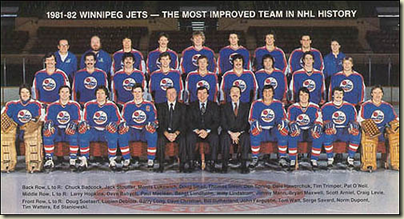
Nine years after the stick snatching incident, Ferguson, now GM of the Winnipeg Jets, took Savard in the 1981 Waiver Draft after the Canadiens failed to properly file his retirement papers.
image

Ferguson was persistent to convince his friend not to retire and two months into the 1981-82 season, Savard finally agreed. He would play two final seasons in Winnipeg  before retiring officially.

A Keane connection: Former Canadiens captain Mike  Keane owes a debt of gratitude to Serge Savard and John Ferguson. Left undrafted, Keane had been playing minor hockey in Winnipeg. Ferguson had watched him play there and gave Savard, now GM of the Canadiens, a call. The rest, as they say, is history.

Sources for this article:

The Montreal Gazette, October 3, 1972

The Montreal Gazette, “How Serge pushed Fergie to the Brink” – by Ted Blackman - August 15, 1981

“Thunder and Lightning” by John Ferguson with Stan and Shirley Fischler

“True Hockey Stories: The Habs” by Brian McFarlane

“’72 From Training Camp to Victory” - DVD


Saturday, January 30, 2010

A Pair of Habs Bargain Book Finds

IMG00017-20100129-1750

Ever had one of those days when you walk into a store, with no real intentions to buy anything, then luck in on a great deal?

Last weekend, I had one of those. My goal was to find a small printer cart or table for my fiancée and her two girls. After not finding any to my liking, or that were reasonably priced, I spotted a discount/clearance store across the street from where I was parked.

“Couldn’t hurt to try,” I said to myself so in I went.

With no luck in the small furniture area, I noticed a used book area in the far corner and decided to see what was there.

I found the sports shelf, and thumbed my way through. Low and behold, there stood out the greatest hockey book ever written, Ken Dryden’s “The Game”.

It was in excellent shape, in light of a small tear on the sleeve in the corner, but on opening it I realized that this was a very early edition (4th printing).

My only other copy was a paperback release, that I had in my possession for over 20 years. To find an early printing was quite a treat, especially at the price of $3.99.

There was even an old 1984 First Choice (now the Movie Network) card calendar between one of the pages. So this copy had likely not been handled too often, and likely by just one owner.

Then I found something peculiar. A page or two in, the inscription “John, He Shoots, he scores! Sincerely, Gordie Howe” was written in blue pen.

The signature had been written over slightly in marker. An added bonus, I wondered. But why would Gordie Howe sign Ken Dryden’s book?

IMG00018-20100129-1751 Later in the day I researched Mr. Howe’s signature, but alas the one in the book doesn’t match up to any I saw online. Perhaps John’s father did it to cheer him up, who knows.

Working my way through the books I hit another jackpot. “Thunder and Lightning” by John Ferguson, and Stan and Shirley Fischler.

This was a better find for me than the other book as for months I had been tracking down a decent copy of this book. A few times it pops up on eBay or in Amazon’s used lists, but my timing, or the ridiculous shipping costs, kept me away from it.

The timing couldn’t have been better either, given the Georges Laraque mess that was going on in Montreal. Here in my hand was the autobiography of the man who basically created the enforcer position, while at the same time the Canadiens had just bought out the man they thought could carry that role or them.

Off to the checkout I went, and passed over the money for my new finds plus a 75th Anniversary NHL book, just under $13 after taxes well spent.

As for the printer cart, I did manage to find one on sale the next day. A successful weekend all around.

Thursday, October 8, 2009

Will Habs fans try to remove Darcy Tuckers’ name from the new monument ?

The Montreal Canadiens will unveil a new monument Friday.

Montreal Mayor Gérald Tremblay, Canadiens president Pierre Boivin and ambassadors and representatives of the team will be on hand at 12:30 pm., at the Centennial Plaza, outside the Bell Centre. 

The new monument will list the names of every player who have played for the Canadiens in their first 100 years.

No word if Marc-André Fortier, the sculptor who created the monuments to Howie Morenz, Guy Lafleur, Maurice Richard and Jean Beliveau already in the plaza, was involved in the latest project.

Gotta wonder if Darcy Tucker’s name will be etched off, by fans, faster than Moses’ was by Pharoah from Egyptian records.

Again!, again!: Following their dismal performance against the Vancouver Canucks on Wednesday, coach Jacques Martin had his team back on the General Motors Place ice for a morning practice with a series of hard skating drills and one-one-one workouts.

“It was an old-school bag skate,” said winger Mike Cammalleri. “Every year you get at least one. We needed it.”

“It’s a message that a coach has to send,” said goalie Carey Price. “We have to be working hard in games or we’re going to be working hard in practice.”

After he was left hung out to dry by his team, Price punched a hole in the dressing room wall after Wednesday’s game.

The 22-year-old did find a positive to the lopsided outcome.

“I don’t like getting scored on,” he said. “But as long as you’re not giving up bad goals, at least you can build on it.”

We’re number 9! :  Spike.com, whose TV network’s creative genius thought Striperella and Gary the Rat were shows capable of competing in a Thursday primetime slot, list Habs fans as the ninth-most annoying in pro sports. The author needs to get some more accurate facts though. Apparently, we’re all French!

On this day in Habs history: Tough guy John Ferguson made his NHL debut. Ferguson was in his first fight, with Ted Green, just twelve seconds into the game and later scored two goals and an assist against the Boston Bruins.


Saturday, September 5, 2009

“We played for the sweater.” – John Ferguson

Ferguson_John_headshot_005From the moment he suited up for the Montreal Canadiens Ferguson vowed to be "the meanest, rottenest, most miserable cuss ever to play in the NHL." The Canadiens had recruited the fierce forward because they felt the team lacked toughness, and John Ferguson delivered in spades.” – Legends of Hockey

One of the toughest players to ever wear a Montreal Canadiens jersey was born on this day in 1938.

John Ferguson grew up in Vancouver, BC. Unlike many hockey stars, he didn’t learn to skate until he was twelve years old.

He was a small in stature in his days as a pre-teen and, at the age of fourteen, he got his first job in hockey as a stick boy for the WHL Vancouver Canucks.

Moving to Saskatchewan the following year, he had a growth spurt and began playing junior hockey with the Melville Millionaires.

In his third year of junior, Ferguson scored 66 points in 44 games.

He played a year in the IHL with the Fort Wayne Comets before joining the Cleveland Barons (AHL) in the 1960-61 season.

He was offensively gifted, as is shown by his AHL First-Team All-Star selection in 1962-63, but it was his toughness and willingness to fight that drew the eyes of scouts from the NHL.

Both the New York Rangers and the Boston Bruins showed interest in the young winger, but it would be Frank Selke’s Montreal Canadiens that would bring Ferguson to the NHL.

The Canadiens had gone without a Stanley Cup in three consecutive seasons. Selke and coach Toe Blake felt that teams lack of a physical presence was a key concern.

The circulating story is that Blake went down to watch a Barons practice. He noticed a frustrated Ferguson firing puck at a teammate who was practicing with little effort. It was enough for Blake to convince Selke to sign him.

0-fergy-2 Ferguson debuted on October 8, 1963, on a line with Jean Beliveau and Bernie Geoffrion, against the Boston Bruins.

Just twelve seconds into the game, the rookie locked horns with the Bruins Ted Green.

In his autobiography, Thunder and Lightning, Ferguson recalled the encounter.

“As I listened to the final strains of ‘Star-Spangled Banner’, I peered over at Green and said to myself ‘John, you might as well start at the top.’

No sooner had the puck been dropped and he came over after me….and POW, I landed one right on Green’s kisser. And another and another.”

By the time it was over, Green, considered the toughest player in the league to that point, realized there was a new sheriff in town.

Ferguson also had two goals and an assist in his debut.

He finished the season as the leagues’ rookie scoring leader. Despite a first-place finish, the Canadiens again failed to win the Cup.

Fergie fighting Nevin The following year, Montreal won the first of four Cups in a five year span and Ferguson closed out the 1968-69 season by scoring the Cup-winning goal. He a career high 29 goals, that season, to go with a league record 80 penalty minutes in the playoffs.

“There was tremendous pride in those days”, he said. “We all got along so well together. We played for the sweater.”

Ferguson’s reputation as an enforcer became known. Few opponents rarely touched the likes of Beliveau, Geoffrion or Henri Richard. If they did, Ferguson made them pay.

Hampered by injuries the following year, he still scored 19 goals. The Canadiens missed the playoffs that season and Ferguson contemplated retirement to pursue business interests.

He made it official on October 6, 1970, but just over a month later, GM Sam Pollock convinced the veteran to return.

The decision was well worth it for him, as the Canadiens defeated the Chicago Blackhawks for another Stanley Cup.

nhl_g_ferguson_200  It was on the trip home that Ferguson decided to quit playing for good.

Jean Beliveau, having already announced his retirement prior to the end of the season, recalled the moment in his autobiography.

“I clearly remember the plane trip home from O’Hare. I sat with Fergie, sharing a few beers, contemplating the future.

The toughest played I’d ever seen had tears in his eyes.

’Jean, I can’t do it anymore’”, Fergie said,resignedly.

‘Reggie Houle carried me all through these playoffs. I can’t do it; I think I’m going to retire with you.’”

Ferguson finished with an even 500 games played, 145 goals, 158 assists and 1214 penalty minutes.

He would be asked to play in the 1972 Canada-Russia series, but elected to take a position as an assistant coach.

In light of not playing, Ferguson’s contribution to the series came in the way of a tap on the shoulder and whisper in the ear to Bobby Clarke during the sixth game.

Clarke went out and broke the ankle of Russian star Valery Kharlamov. With him out, Canada went on to win the series.

Ferguson would later go on to be a  coach, and then GM, for the New York Rangers.

He would later join the WHA Winnipeg Jets as their GM, winning an Avco Cup. He kept his position there for another decade during the team’s transition to the NHL and coached for one season.

He later worked in the front office for the Ottawa Senators and as a scout for the San Jose Sharks.

Sadly, Ferguson’s toughest opponent came in the form of prostate cancer in 2005. After two battles with the disease, he passed away in July of 2007.

Ferguson memorial 3 Scotty Bowman admires a photo tribute at John Ferguson’s funeral

Quotes and facts on John Ferguson.

  • “Ask me my choice of the ten most popular players in the last fifty years of the Montreal Canadiens, and Fergie would be near the top of the list.” – Dick Irvin
  • “He’s a throwback to the old time hockey players. He’s absolutely fearless and he’s strong. There aren’t too many Ferguson’s left in the NHL and the league is all the worse for that.” – Maurice Richard
  • “When you had Fergie as a friend, he was a friend for life. You know, we won a lot of Cups with that guy … I loved the guy.” – Serge Savard
  • “When Ferguson came to training camp, there were some skeptics who said he wouldn’t make the grade. Ferguson has happily proved them wrong.” – The Hockey News, 1963
  • Ferguson was the offered the chance to fight Canadian heavyweight boxing champion George Chuvalo in a three round exhibition at the Toronto CNE grounds. Sam Pollock did not allow it.
  • In light of his tough play, he only led the league in penalty minutes once in his career (1966-67). That same season he became the first player to receive a triple-minor in a game vs. Detroit.
  • His fight with Green was the fastest fighting major for a rookie.
  • Appeared in two All-Star games (1965, 1967)