Showing posts with label Stanley Cup. Show all posts

Tuesday, September 7, 2010

Canadiens Hall of Famer Jacques Lemaire turns 65

Lemaire_Jacques_1

OK so now we can say he’s officially retired! Happy 65th to Jacques LeMaire.

The Hall of Fame centre with the Canadiens, and current coach of the New Jersey Devils, was born on this day in 1945.

When you look at Lemaire’s statistics during his twelve-year career with the Montreal Canadiens, one thing that gets overshadowed was his defensive ability.

He was once referred to as Guy Lafleur’s defensive conscience during the Canadiens run of four Stanley Cups to close out the ‘70s.

His speed, anticipation and determination allowed Lafleur and linemate Steve Shutt to excel more offensively. Lemaire was the workhorse, winning the faceoffs, and digging pucks out of the scrums and getting the puck to his sharpshooting wingers.

In an interview with the Hockey Hall of Fame in 2007, Lemaire gave insight into the importance of a good defensive forward.

"We talked more about defence than offence. It was always there. I remember my first year playing for Toe Blake -- he was always talking about it.

On the bench, he'd be telling us if this guy or that guy didn't come back on defence and he would bench them. You hear people say their team needs more offence and forget defence.

That's crap! Defence is what we talked about. Somebody has to get back and help the defense. We knew we could score enough goals. We didn't want to give goals to the opponent because if they got a goal, we had to get two."

Jacques_Lemaire Lemaire’s defensive capabilities made the Canadiens top scoring line even harder to play against, and he never went a season, since his rookie debut in 1967, without scoring less than twenty goals in a season. He’s finish with 365 goals (7th in Habs history) and 469 assists (5th) for 835 points (7th) in 853 regular season games. Lemaire had a career plus/minus of +349.

During the playoffs, Lemaire brought it up another notch. His 139 career playoff points put him second behind Jean Beliveau. He played on eight Stanley Cup winners with the Canadiens.

He had three overtime playoff goals in his career including Cup clinchers in 1977 and 1979. Only five other players have scored more than one overtime Cup winner.

Not positive, but could be Lemaire’s Cup winner in the 1977 Finals.

His 1979 Cup winning goal would be his last in the NHL.

Lemaire retired from the NHL and spent two seasons as a player-coach in Switzerland. He later returned to become head coach with Montreal at the end of the 1983-84 season, taking the team to the Wales Conference Finals. The following season, Montreal finished first in their division, but lost in the second round of the playoffs.

That summer, Lemaire became a member of the Hockey Hall of Fame as a player.

The pressure of coaching in Montreal grew too hard for Lemaire and the following season he moved to the front office to become the Assistant to the Managing Director for eight seasons. The Canadiens would claim two more Stanley Cups (1986, 1993) over that span.

He then took a position as head coach with the New Jersey Devils in 1993 and developed what is now known as the “Trap" System”. He would win the Jack Adams award as coach of the year that season.

Coupled with the goaltending of Martin Brodeur, the Devils won the Stanley Cup in 1995 and Lemaire remained with New Jersey until 1998.


lemaire_jacques_adams_trophy

He was hired as the first coach of the Minnesota Wild in 2000, winning a second Adams Award in 2003, remaining there until he stepped down until the spring of 2009, returning to New Jersey.

After one final season with the Devils, he retired as an NHL coach in April of 2010 with 588 wins and a .561 win percentage.

090402-lemaire-hmed-11a.hmedium


Tuesday, August 31, 2010

Chelios hangs’em up, 20yrs after a career-threatening injury

The Montreal Gazette - Google News Archive Search

In the June 11, 1981 edition of the Montreal Gazette, Chris Chelios’ name only appeared in the middle of a list of players, selected by the Montreal Canadiens, at the NHL Entry Draft the day before.

Chelios was the 40th player selected overall, and clearly the hidden gem of the draft. The Canadiens were lucky to get him, considering they had already made four picks (three in the first round) before selecting him.

The highlight of the media attention at the draft for the Canadiens at the time was Mark Hunter. But even hockey was taking a backseat, as the major news in the Montreal sports world was the 1981 baseball strike, just 24 hours away. The threat of the strike made the first page of the sports section, while the draft was one page over.

After being a star junior defenseman with the Moosejaw Canucks, Chelios joined the U.S collegiate ranks. Under “Badger” Bob Johnson, Chelios won the WCHA Rookie of the Year award, and was an NCAA champion by his sophomore year.

By this time, Canadiens GM Serge Savard knew what kind of a talent his predecessor Irving Grundman had drafted.“We’ve got this kid Chelios, that could play for this team right now,” Savard said feeling that Chelios could easily find himself a roster spot.

Even noted Montreal writer Red Fisher saw it in Chelios in an 1983 article, when he said, “He’s the best example of low drafts on high talent.” Fisher developed a strong media-player bond with the blueliner throughout his career. More on that further on.

image

Chelios got a first taste of the NHL during the 1983-84 season, seeing 12 regular season games, and fifteen playoff games as the Canadiens fell to the eventual Stanley Cup champion New York Islanders in the Conference Final.

The following season, he was in the NHL to stay and made the All-Rookie Team, and finished second to Mario Lemieux for the Calder Trophy. He would get his first taste of Lord Stanley’s mug a year after that as the Canadiens took their 23rd Stanley Cup.

1988-89 was a bitter-sweet season for Chelios. He won his first Norris Trophy, and a First-Team All-Star birth, but the Canadiens fell short in the Cup Final against Calgary.

image

By the end of the 1989-90 season, the party was over in Montreal for Chris Chelios. One side will tell you that team president Ronald Corey was tired of Chelios’ alleged extracurricular activities, and forced Savard to trade him.

Savard tended to say otherwise, going on doctors advice that the knee injury the defenseman suffered in February would shorten his playing career.

So in June of 1990, Chelios was traded to the Chicago Blackhawks for Denis Savard. The deal was a head scratcher to fans, media and Canadiens coach Pat Burns.

Twenty years later, Serge Savard must be wondering where his doctors got their medical degrees.

1249 regular season games, four First Team All-Star selections, two Norris Trophies and two Stanley Cups after the trade, Chris Chelios has finally hung up his skates at age 48!

During his retirement speech on Tuesday, Chelios singled out the Montreal reporter who always saw something in him and believed in him from day one.

"The one guy I’d really like to thank is Red Fisher out of Montreal, who, if I could ever have a personal relationship with a member from the media, it’s about as close as it could come," Chelios said.

"Red was there from Day 1, really took care of me, actually. Offered me advice, pulled me aside a lot, was a great friend to my wife, at the time I didn’t have any children.

He really showed me a lot in how to deal with the media. I failed sometimes, but for the most part, I took it to heart what Red told me. Very sarcastic sometimes, but always gave me good advice.

So Red, I just want to wish you and your family the best. Hopefully this will get back to you, and I can’t thank you enough what you did for me."

Chelios officially accepted a position with the Detroit Red Wings, where he won his other two Stanley Cups, on Tuesday to become an Advisor to Hockey Operations.

“I'm 100-percent sure that this is it. I know that I'll never play in the NHL again,” he said. “It's not a hard decision. I couldn't have played any longer than I did. I accomplished what I wanted to. Basically, there's nothing left.”

There’s two things left however to finish his playing career, eventual enshrinement in the Hockey Hall of Fame and the U.S. Hockey Hall of Fame. Both of those should come by 2013.

Congratulations Mr.Chelios, on 27 wonderful years.

and of course, how could we not include this?!

More on Chelios’ retirement

Michael Farber (Sports Illustrated)


Newspaper sources:

Montreal Gazette – June 11, 1981

Montreal Gazette – June 4, 1983


Tuesday, June 1, 2010

Video Clips from the Habs Blackhawks ‘65 Final

Instead of doing a retrospective of Jacques Martin’s first calendar year as Montreal Canadiens head coach, I thought I’d throw up a couple YouTube Clips from the 1965 Stanley Cup Final.

The series would be a seven-game ordeal between Montreal and the Chicago Blackhawks.

I think these vids will be more entertaining than a best-of video montage of Martin’s pressers, don’t you?

Game Five (April 27): The Canadiens took the game with a 6-0 pasting of Chicago. Things got rough when John Ferguson and Eric Nesterenko had at it.

Game Seven (May 1): The Canadiens win the game 4-0 to claim a 13th Stanley Cup. This is the closing minutes of the game that includes the Cup presentation and the first ever Conn Smythe Trophy to Jean Beliveau.


Monday, May 31, 2010

Habs John McCormack stopped Mr. Hockey at 49

image

John McCormack isn’t one of the standout names in the history and lore of the Montreal Canadiens in the 1950’s, but he had a key hand during the team’s 1953 Stanley Cup run.

A Memorial Cup winner, with the St. Mike’s Majors in 1945, McCormack got his break in the NHL with the Toronto Maple Leafs during the 1947-48 season. He only played three games that season, and just one the following season.

McCormack spent a pair of part-time seasons between Toronto and the minors after that. Playing 46 games, during the 1950-51 season, was enough to get his name on the Stanley Cup, despite being in Pittsburgh (AHL) during the playoffs.

His demotion had been a result of a mid-season marriage to his pregnant girlfriend. It was something that enraged Leafs owner Conn Smythe.

"I was playing with Pittsburgh and we were in Cleveland that night,” McCormack said, in 2005 interview with the Hockey Hall of Fame. “We lost that night and they (Toronto) won that night with Billy (Barilko) scoring the goal. I was very pleased for him.”

Despite the Leafs adding his name to the Cup roster, Smythe sold McCormack’s rights to the rival Montreal Canadiens the following summer. One could argue for Smythe that McCormack’s offensive numbers never lived to expectations he had in Jr. and in the OHA.

In Montreal, coach Dick Irvin found good use for McCormack’s other talent as a defensive specialist.

In his second season with the Canadiens (1952-53), the gritty centre found himself in a pivotal role on the last game of the regular season.

Montreal would be in Detroit to face Gordie Howe and the Red Wings. Sitting on 49 goals, Howe needed just one to reach the illustrious 50-goal mark, something only the Canadiens Maurice Richard had achieved to that point.

McCormack and linemate Bert Olmstead were in charge of checking Howe. Whenever “Mr. Hockey” was on a shift, one or both of the Canadiens forwards was out there on him.

The prominent checking pairing off, as Howe had only one decent and unsuccessful scoring chance on the night. It was the closest The Red Wings legend ever came to 50 goals in his career, and it would be another eight years until Bernie Geoffrion became the NHL’s second 50-goal scorer.

“The Rocket always had that competitive fire,” McCormack said during brief chat with me at a recent Toronto autograph signing. “Afterwards, he came over to me and Bert and thanked me for not letting Howe get to 50.”

The Canadiens would go on to win the Stanley Cup, with McCormack seeing action in all seven semi-final games and the first two of the Finals.

image

John McCormack with the Stanley Cup on his 80th Birthday in 2005 –Photo: Walt Neubrand HHOF

He would have one final season with Montreal, while spending 16 games with their AHL affiliate in Buffalo, and was in the bizarre seven game Stanley Cup Final against Detroit.

“Let’s see, 1954,” McCormack said as he began to sign a puck.

“Oh no sir,” I said. “You won with Montreal in ‘53. You might have won in ‘54, but Doug Harvey “threw it” into your net in overtime.”

“That’s right,” he replied with a smile. “Thanks for re-educating me.” I failed to note he signed his Leafs number (20) instead of the No. 17 he wore in Montreal.

In the summer of 1954. McCormack was left open to the Intra-League draft, and would play one last NHL season with the Chicago Blackhawks. He retired from hockey, after a season in the WHL with his hometown Edmonton Flyers,at age 30.

Article Sources

Montreal Gazette – March 23, 1953

Hockey Hall of Fame - “Stanley Cup Journal #21”

Legends of Hockey – Player Profile

Greatest Hockey Legends


Saturday, May 29, 2010

Ab McDonald's bridged Cup run between the Habs and Blackhawks


Alvin Brian "Ab" McDonald would probably be considered a power forward of his era. Standing a very solid 6'3, the now 74-year-old greeted fans and collectors at a Toronto appearance this weekend. For a man 35 years removed from the playing the game. he still looks to be in the best of shape.


McDonald joined the bably bruised Canadiens roster, at the end of the 1957-58 season, after a successful year in Rochester (AHL) that saw him score 30 goals. Despite injuries to several key players, he only appeared in two games of the Stanley Cup Finals, against the Boston Bruins. McDonald just had a had a single hooking penalty to show for his efforts, but nonetheless his name was etched on the Stanley Cup for his contribution.


The next season, McDonald was playing full time, and began to show his offensive abilities with 13 and nine-goal seasons. Not bad for a third-year player on a team stacked with future Hall of Fame players.


With another pair of Cup wins in his pocket, McDonald was looking forward to another season in Montreal. It didn't happen as he would be traded to the Chicago Blackhawks in a multi player deal.


Though disheartened to be going from a team that had just won it's fifth straight Cup to a team that hadn't see one since 1938, McDonald wouldn't let that stop him. The Blackhawks had a team of young and eager players, led by Stan Mikita, Pierre Pilote and Bobby Hull, and an iron man goaltender named Glenn Hall.


The Blackhawks would face the Canadiens in the semi finals that year, and led by Hall's brilliant goaltending, would oust Montreal in six games. Nursing a skin infection McDonald didn't see action until Game Five, but recorded a goal and an assist against his former team.


Chicago would square off against the Detroit Red Wings in the Finals. The Blackhawks had the Red Wings in a predicament by the sixth game. Down 3-2 in the series, Detroit would be without goaltender Terry Sawchuk, who had been injured in Game Five. Chicago put the pressure on the Red Wings and backup goalie Hank Bassen after a Reg Fleming shorthanded goal tied the game at one apiece.


McDonald's goal at 18:49 of the second period, when he cased a reboun off a Hull rush, would be the Cup clincher in a 5-1 Blackhawks win. McDonald was named the game's first star and he now had four straight Stanley Cups to his name.


He would go on to have successive 20-goal season the next two years, with the Blackhawks, reaching the finals again in 1962, but losing to the Toronto Maple Leafs.


After a season in Boston, McDonald found himself in the finals again in 1966 playing with Detroit. however he was on the losing end as the Canadiens defeated the Red Wings in six games, in light of a Conn Smythe performance from the Wings' Rogr Crozier.


Expansion brought personal success to McDonald, first scoring 22 goals for the Pittsburgh Penguins, then 21 and 25 the following years with the St. Louis Blues. In St. Louis, he was back in the Stanley Cup Finals but again fell to the Canadiens and Bruins in succesive seasons.


By 1972, McDonald was names captain of his hometown Winnipeg Jets in the new WHA. He would go on to score the franchise's first goal on October 12, 1972, retiring after two seasons with the Jets.


************************************************************************************

More on the Blackhawks '61 win at Habs Eyes on the Prize

Sunday, May 23, 2010

John LeClair: Not picking sides in the Eastern Conference Final

image

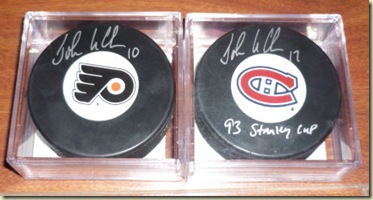
Former Montreal Canadiens and Philadelphia Flyers forward John LeClair was in Toronto, over the weekend, for a rare autograph session at AJSportsworld.

Leading up to Game Four of the Eastern Conference Final between two of his former teams, I had a chance to sit backstage before public the signing to chat him up on his career and playing on and against his two teams.

“I don’t do many of these at all,” LeClair said as he finished up the back room signings. “I’m in town for this one and another project, then I fly home later today.”

LeClair’s most notable highlight with the Canadiens came during Games Three and Four of the 1993 Stanley Cup Finals, where he score the overtime winners in both games.

By the time the 1994-95 got underway, the Canadiens were struggling. Having played most of his career on the Canadiens second or third lines, the team even tried moving LeClair to centre in a desperate attempt to boost the offence.

With things still not working, Montreal traded LeClair and Eric Desjardins as part of a package to the Flyers for Mark Recchi on February 9, 1995.

“The team was struggling at the time, especially on offence,” LeClair said. “It was hard to leave the team, because I had some great friends and good memories there, but it turned out for the best.”

At the time, the Flyers had been five years removed from the playoffs and were looking for a defenceman. In giving up Recchi (93 goals over the last two years) in the deal, they needed some scoring to fill the void.

“We had to get an experienced NHL defenceman,” said then Flyers GM Bob Clarke at the time of the deal. “With the two forwards (LeClair and Gilbert Dionne) we hope that we can compensate for the goals that we gave up.”

Dionne never panned out and was out of the NHL by the end of the 1996-97 season.

P1060088

LeClair’s career on the other hand took off. Put on the Flyers’ top line. a line with Eric Lindros and Mikael Renberg, he scored 14 points in his first seven games. He  also surpassed his previous career single-season goal total of 19 with 25 in just 37 games.

I asked LeClair if the pressure of Montreal affected his play. Surprisingly he didn’t think that made much of a difference, “I enjoyed playing in both cities, but it was a real good chemistry between us that worked in Philadelphia.

“We also played a more offensive oriented style than in Montreal and that helped.”

When it came to playing his former team, LeClair certainly tore up the score sheet.

In 34 games with the Flyers, he scored 28 goals and added 17 assists. He also had a plus-23 rating and the Flyers were 20-10-4 against Montreal with him in the lineup.

One thing LeClair never got to do was play his former team in the playoffs. “I had some good success against them,” he said in a modest tone. “Things never worked out for us to meet in the playoffs.”

Despite his great personal success with the Flyers, that saw him score three straight 50-goal seasons and ranked fifth all-time in Philly with 333, he never got to hoist another Cup.

That’s not to say the Flyers tanked in the playoffs, because they certainly didn’t. In his first season they reached the Conference Finals before bowing out to the, eventual Cup winners, New Jersey Devils.

Two years later they were swept in the Stanley Cup Finals by the Detroit Red Wings and would see two more Conference Finals (2000, 2004) where they took the eventual Cup champions to seven games.

“We had some chances, but we came up against some really good teams,” LeClair said. “Detroit had a great team and the (two) series against New Jersey were really tough.”

image

Now 40 (he’ll be 41 in July), LeClair hasn’t suited up in an NHL game since being released by the Pittsburgh Penguins in 2006. He still looks to be in great shape for a player nearly three years removed from the game.

“No one’s called me yet,” he laughed when I asked about him being “unofficially retired” and still classed as a UFA in the NHL. “I get out on the ice with my kids once in a while but that’s pretty much it.”

LeClair was inducted into the U.S. Hockey Hall of Fame last December. He is the first American-born player in the NHL to record three straight 50-goal seasons.

The question asked by myself and nearly everyone who was at the signing was who he felt was going to win this year’s Eastern Conference Final. LeClair was very diplomatic in his responses, not conceding to either team.

“It’s been a great playoff run and both teams have shown that they’re not going to give up. We saw that in the last game (Game Three),” he said. “This series will go six or seven.”

How good against Montreal was he?: John LeClair had four  games with three or more goals in his career against the Canadiens. His first came in his first game back against his former team, on Patrick Roy, in a 7-0 Flyers win.

Most difficult goalie to score on: Without looking at stats to back it, LeClair felt Dominik Hasek was the toughest goaltender to play against. “He was so unpredictable,” LeClair said. “You never knew what he was going to do.

Most aggravating opponent: Surprisingly LeClair never had many issues with opposing players getting into his face, that unenviable task fell to his longtime center. “Eric (Lindros) was almost always the target,” he said. “Their guys were always going after him. It made things a lot easier for me to do my thing.”


Monday, May 17, 2010

Habs system needs a change of direction for Game Two

image

A failure by the Habs in the direction of their strategy, and they could find themselves at the end of their playoff rope.

Ok, so it’s only Game One. There’s no need to panic. Jaroslav Halak got chased out in Game One against the Pittsburgh Penguins too, don’t forget.

But to lose 6-0 to the Philadelphia Flyers with Michael Leighton in goal, was clearly the Montreal Canadiens worse game of the playoffs.

There were several costly mistakes across the board. Foolish penalties, bad defensive plays and sloppy point play, especially with the man advantage, were the biggest of them.

The most concerning issue though might be the style the Canadiens are trying to play against the Flyers.

An east-west/dump and chase style is not going to work against a Flyers defensive quartet led by Chris Pronger, plain and simple. It didn’t work in 2008 either without Pronger, you think it will work now?

The Philadelphia defense clogged up lanes. blocked shots and had an easy time fetching pucks out of their own zone. The Canadiens 11 giveaways and Flyers 12 takeaways reflects that.

In essence, the Canadiens made it too easy for the Flyers, and their goaltender who had no problems seeing the puck Sunday night.

The Canadiens attackers also have to be patient and not try to do it alone. Many a time, the Flyers forwards would wait, circle back inside the blueline and allow their teammates to attack the net. We basically saw a clinic on that.

A key example of how not to do it came on the sixth Flyers goal. P.K. Subban attempted a one-man rush and got shut down, leaving Maxim Lapierre to play defense and hung out to dry.

It was interesting too, on Coaches Corner, how they centered on Subban and how he’s been playing the same way since Bantam. You think Flyers scouts figured that out, or noticed it in the playoffs?

Philadelphia knows how to shut down a team’s offense if they come right at them, the Boston Bruins will tell you that. Leighton does have to come up with some big saves, but he’s not stealing games like Halak has in the first two rounds.

To be effective against the larger Flyers defense, the Canadiens have to play more north-south against the Flyers, playing them off the boards to open those scoring lanes. Do that and they wear the defense down and expose the weaker pairs.

If they don’t and continue with the Game One offensive strategy, this could be a quick series. You can expect Jacques Martin and Kirk Muller make the adjustments required on Tuesday.

The Canadiens other problem lies in the size department in their own end.

Of the four Flyers’ goals that beat him, how many clean shots did Halak actually see? Hal Gill and company were blocking their share of shots (20 in total) but they have to get the bodies out of Halak’s way. It wouldn’t be surprising to see Ryan O’Byrne back in the lineup for Game Two to help nullify this problem.

Failure to get the Flyers behemoths out of their own crease will make it a shooting gallery for Danny Briere and the like, and a Sunday afternoon tee time at Le Club Laval Sur-le-lac for the Habs.


Tuesday, April 13, 2010

April 13, 1944: Durnan and The Punch Line lead Habs to their fifth Cup

STC1944Bill Durnan wrapped up his first season in the NHL as effectively as it began.

The 29-year-old rookie had already claimed the Vezina Trophy, and was a unanimous pick to the First All-Star Team (a first for a rookie), as he led the Montreal Canadiens to first place in the 1943-44 standings.

The Canadiens lost just five games that season, allowing just 109 goals in 50 games. By comparison, the second fewest goals allowed were by the Toronto Maple Leafs with 174.

Up front, coach Dick Irvin finally found chemistry for struggling winger Maurice Richard. In December, the left-handed shooting Richard was put on the right wing with veterans Elmer Lach and Toe Blake. The Punch Line was born, blending in with a well-balanced Canadiens offense (six players had 20 or more goals) that didn’t slow down entering the semifinals against Toronto.

The Leafs would pull off a surprise 3-1 victory in Game 1, but that would be as far as the blue and white would get. The Canadiens won the next four games, with Durnan allowing just three goals the rest of the series. In the final game, he shut Toronto out as the Canadiens humiliated their rivals 11-0.

Richard scored seven goals in the series, including his famous five-goal Game Two (March 23)that earned him all Three Stars of the game. The Rocket’s legend was beginning, but as history would show, he was just getting warmed up.

The Canadiens would move on to face the Chicago Blackhawks in the Finals.

Chicago had upset the Detroit Red Wings in five games and came in with some offensive firepower of their own. In fact, Doug Bentley, Clint Smith and Bill Moisienko had a better combined point total than Montreal’s top trio in the regular season.

It would be Richard’s first Final appearance and he would not disappoint. Backed by the goaltending of Durnan, the Canadiens would prove to be no match for the Cinderella hopefuls from the Windy City.

The series took a peculiar format due to lack of ice availability at Chicago Stadium. The first game would be played at the Montreal Forum with the next two games played in Chicago. Game Four, and any remaining games needed, would be played in Montreal.

Montreal took Game One at at the Forum, showing their scoring depth, by a 5-1 score

Game1_Boxscore 

In Chicago Richard scored all three goals in the Canadiens 3-1 win in Game Two.

Game2_Boxscore

In the third game, the Blackhawks managed to get 23 shots at Durnan. Many came from the outside and were easily stopped as Montreal steamed on with a 3-2 victory.

Richard had a single assist in the game, on a second period goal by Blake, that would break the playoff scoring record with his 15th point. It would be a short lived record.

Game3_Boxscore

The series moved back to the Montreal with the home team seeking the four-game sweep.

Chicago was not going away easy, and took a 4-1 lead midway into the third period. The forum crowd became angered and started to jeer the Canadiens players. Some even yelled out “Fake!”, feeling their team was throwing the game.

Blake’s squad, an more so the Punch Line, took the crowd’s reaction to heart, and exploded on the Blackhawks.

Lach responded first with a goal,that bounced off the skates of Blackhawks goaltender Mike Karakas, to cut the lead to two with around five minutes to play.

Then a first in Stanley Cup play occurred when the Canadiens Leo Lamoureux tripped up Virgil Johnson on a breakaway. Johnson would be awarded a penalty shot. A Chicago goal would more than likely end any chance for a Montreal rally. Durnan turned aside the penalty shot and stood his ground the rest of the night in the Montreal goal.

Shortly after, it was Richard’s turn. After Blake foiled a Chicago attempt to put the game away, the trio worked up the ice where Blake fed the Rocket the puck. Richard moved in, stopped and drilled the puck past Karakas.

The Forum erupted in jubilation as the Canadiens were within one.

“It was one of the most sensational goals in a Stanley Cup series,” said broadcaster Doug Smith. “This boy Richard beats you all the time. Just when you think he’s scored a goal that defies all description, he comes across with another one.”

Irvin kept his best weapons on the ice in an effort to tie the game, and his players wouldn’t let him down.

Chicago pushed the puck back into the Canadiens zone, but defenceman Emile “Butch” Bouchard stripped Bentley and moved the puck back up the ice. Once the Canadiens broke the blueline, he flipped the puck into the corner for Blake. Again, the veteran found Richard.

Within a minute and 15 seconds, Richard had potted two goals and the game was tied at four.

The game went into overtime where Blake finally put the Forum crowd at ease at 9:12. Durnan and Lach lifted the overtime hero on their shoulders as the crowd cheered and debris littered the ice.

BlakeOT Toe Blake scores the overtime winner in Game 4 – Montreal Gazette Photo

Game4_BoxScore

The Montreal Canadiens had won their first Stanley Cup in thirteen  years. The proverbial torch was being passed from the legends of Morenz and Joliat to the new guard of Blake, Lach and Richard.

Irvin stood proud of the team that proved the skeptical crowd wrong.

“There are always people who think everything is fixed and I suspect they must be shady themselves,” the coach said. “The chanting made my players see red. Why, they tied the score with in ten minutes after hearing those taunts and Toe Blake almost tore off the back of the net with his overtime counter.”

HabsWin The Canadiens celebrate their fifth Stanley Cup – Montreal Gazette photo

Richard finished the series with five goals in the Finals as he and his linemates scored 10 of the teams 16 goals. His twelve goals in the playoffs were a new league record.

Blake had factored in on all five goals on the night and jumped ahead of Richard for the playoff scoring race, breaking the league record yet again in the same season.

Some Canadiens Stanley Cup Fun and Games

Bill Durnan not only thwarted the opposition on the way to his first Stanley Cup, but also thwarted his teammates practical jokes along the way as this April 12, 1944 Montreal Gazette shot demonstrates.

Durnan_joke_041244 The photo on the left shows Durnan dumping water on the head of  Murph Chamberlain as he attempts a hot foot on Toe Blake.

Stanley Cup Typos

SCJ05_16h

You’ll notice a few typos on the Cup after the Habs won in 1943 (Bill Durman, Leo Lamoureuz). Durnan’s name was corrected when a Replica cup was created in 1992-93.

Gerald Heffernan won just one Cup in his career but had his first name redone three times. It was originally stamped as Gerald in 1944, then Jerry when the Cup ring was redesigned in 1958 and later Gerry in 1993 on the Replica ring.

Sources for this article:

Pittsburgh Post-Gazette April 5 and 7, 1944

Montreal Gazette April 6-14, 1944

Diamond, Dan, 2008 Playoff Media Guide:Total Stanley Cup

Jenish, D’Arcy,  The Montreal Canadiens: 100 Years of Glory

McFarlane, Brian,  True Hockey Stories: The Habs


Monday, April 5, 2010

April 5 1970 – A Close Race Leaves Habs on the Outside

StandingsThe 1969-70 NHL season saw the previously last-place Chicago Blackhawks soar to the top of the East. The two-time defending Stanley Cup champion Canadiens would not make the playoffs.

The 1969-70 NHL regular season might have had the most bizarre finale in league history.

The league’s Eastern Division composed of the Original Six squads and the West made up of the Expansion Six. With the established teams clustered together, it made the standings appear rather lopsided.

The Eastern Division had five teams with 90 or more points going into the final two games. Five points separated leading Boston and Detroit from the fifth place Rangers. The Toronto Maple Leafs were well back and out of playoff contention.

Calculations made on a computer had  a reported 125 different possible scenarios for a final result in the standings. The fact all six teams played home-in home inter-division matchups added to the confusion.

The final Saturday saw the Detroit Red Wings clinch a playoff spot with a 6-2 win over the Rangers. Chicago took the Canadiens 4-1, while the Bruins beat the Leafs 4-2.

Now it was getting interesting. The Rangers were still two points back of fourth place Montreal. A Ranger win and a Montreal loss on Sunday would give them equal standing in points and wins.

The first tiebreaker at the time was wins, followed and by goals scored and then was goals against. New York had a seven goal advantage over Montreal in goals against, but the Canadiens had 242 to 237 goals for margin entering the final game.

New York would have to not only come out Sunday with a win and a Canadiens loss, but they would need to score five more goals than Montreal would to make the playoffs.

It would be an advantage would befall the Rangers.

Having clinched third place, and no way to move up on Chicago or Boston or down, Red Wings coach Sid Abel had already planned to sit his star players for most of Sunday’s game.

Some overnight celebrating by Gordie Howe and co. also left many a Red Wings player with a hangover on Sunday afternoon. Garry Unger even admitted to the celebrations during an between-period interview during the game.

crozier The Detroit Red Wings  Roger Crozier lays flat in his net during a 65-shot pelting from the New York Rangers 04/05/70 Photo: The Hockey Encyclopedia

The end result was a 65-shot battering of Red Wings goalie Roger Crozier and a 9-5 Rangers victory. Poor Crozier was not even expected to play the full game either, but backup Roy Edwards was in the training room suffering from “headaches and chest pains.”

The Canadiens players watched the game on national television that afternoon and were shocked and infuriated to see the Red Wings lay down like that.

A team that need five goal margin came out with nine. Now the Canadiens needed either a single point, or at least muster up five goals against a man who recorded 15 shutouts that season, Tony Esposito.

With Chicago still in the hunt for first place, there would be no laying down from the Blackhawks. For Esposito, who was left unprotected by the Canadiens in the 1969 inter-league draft, it would be an opportunity for some payback.

“One lousy point, gang, that’s all we need,” a frustrated John Ferguson said as Canadiens’ team bus made it’s way to Chicago Stadium. “Screw those other guys. We’ll do it ourselves.”

The Canadiens got on the board first, on a goal by Yvan Cournoyer. Chicago responded with goals from Pit Marin and Jim Pappin.

A 3-2 lead was not going to cut it after two periods. It didn’t help that the Blackhawks also had the outstanding goaltending of Esposito behind them.

Twice in the first two periods, Esposito came up big. First was a goal-mouth stop on Jean Beliveau and then a big stop on Henri Richard in the second. The latter stop was cited as a turning point by Canadiens coach Claude Ruel.

Word from Boston rolled in on the scoreboard with the Bruins leading 2-1 then finishing with a 3-1 victory over Toronto. That sent the Blackhawks going as Martin scored two more times in the first half of the third period.

It was then that Ruel got desperate. A win now seemed unlikely, and a tie was an outside shot. The Canadiens needed three goals to make the playoffs. Ruel pulled Vachon in an attempt to get those goals.

The netminder would be in goal only if there was as faceoff in the Montreal end, or after a Chicago goal. It failed miserably, much to the humour of the Chicago Stadium crowd, to the tune of five unanswered goals from the Blackhawks.

empty_net A shot of the empty Canadiens goal 04/05/70 – photo: The Hockey Encyclopedia

Down by an eight goal margin, Ruel humbly put his goalie back in the net to close out the last two minutes when Gerry Pinder scored the final goal.

BoxScore_04061970

The game was cited as a “black day for Canada” by the CBC announcer after the 10-2 final score. For the first time in 22 years, the Montreal Canadiens were not in the playoffs. Players across the NHL, including the rival and eventual champion Bruins were shocked to not see the Canadiens in the post-season.

“It was like a bad dream,” said Henri Richard, who had never missed a playoff in 14 years.

“It’s hard to blame the Red Wings because you can’t expect another team to help you if you can’t make the playoffs 75 games,” said injured Canadiens winger Mickey Redmond. “But they (Detroit) didn’t have to lay down and die.”

“We can’t blame Detroit for our problems, we have only to blame but ourselves,” said Ruel. “But They (Detroit) didn’t work at all.”

Who was too blame?

To say the Canadiens 1969-70 season was as Ruel called it, “a year of frustration.” might be spot on.

Much of the Canadiens playoff failure was pointed at Ruel, who was questioned on his leadership, handling of players and strategy making.

One of those in attendance in Chicago that Sunday night was then St. Louis Blues coach Scotty Bowman. “I think Montreal played too conservatively, looking for a tie,” he said. “That’s asking for a lot on Chicago ice. If the Canadiens had gone all-out offensively and forgotten defense, I think they’d have scored five.”

“The ship has foundered without the firm, confident hand of a Toe Blake, or Dick Irvin to steer it,” wrote Montreal Star columnist John Robertson. “In their place, a nice little guy turned bitter and confused, blaming the players for failing him.”

In fairness to Ruel, he had inherited a team from the legendary Blake the season prior. If that’s not pressure for a rookie coach, then what is? After the Canadiens clinched the Stanley Cup in the spring of 1969, the rookie coach was dead from exhaustion.

Midway through his sophomore season, Ruel had gone to GM Sam Pollock and told him that his hold on the players was failing.

“I can’t take it anymore Jean,” Ruel admitted to Beliveau as recalled in the Canadiens legend’s biography. “I want to go back to scouting. That’s where I’m happy.”

Pollock urged him to stay on, and he did.

Fingers pointed elsewhere as well. Pollock was criticized for trading future Hall of Famers Gump Worsley and Dick Duff, who battled both Ruel and personal problems, and for letting Esposito go for nothing.

“We blame ourselves. We lost. It’s not just one game, it’s a whole season that decides it,” said Pollock. “That’s the crux of the whole bloody thing.

Injuries also hampered the Canadiens throughout the 1969-70 season. Serge Savard, the Conn Smythe Trophy winner in 1969, missed the last dozen games with a broken leg. Ferguson missed 18 games via injuries or suspension, J.C. Tremblay had missed 17 games early in the season with a wrist injury. Beliveau and Richard also were out 13 and 14 games respectively from injuries.

There was also a collapse by the Canadiens between February 14 and March 8 that saw them win three of ten games.

But if anything was a sign of how bad the season went, it was the Canadiens home-in-home series against the Rangers the weekend prior to that fateful final game. The Canadiens salvaged just a tie from those two games (March 27 and 28) against New York.

“We picked up only one point in the last weekend of the schedule, against teams we had to beat,” said winger Claude Provost. “We hardly deserved to be in the playoffs.”

Aftermath

After much criticism from the ending to the regular season, the NHL restructured the tie-breaker format. After wins, the results of the head-to-head series between the two teams would be the second tie-breaker. Had that happened in April, 1970 the Canadiens would have won with a 4-3-1 record.

The next season Ruel was getting no further with his team and they were 11-8-4 in December. Pollock finally let him go, replacing him with Al McNeil, and the Canadiens went on to the Stanley Cup. Ruel stayed on as Director of Player Development and would return as coach in the 1979-80 season.

Related Articles:

Habs Eyes on the Prize

Sources:

Montreal Gazette April 6, 1970

Beliveau, Jean (w Goyens Turowetz), Jean Beliveau: My Life in Hockey

Ferguson, John (w Stan and Shirley Fischler) – Thunder and Lightning

Jenish  D’Arcy, The Montreal Canadiens: 100 Years of Glory

Ronberg, Gary, The Hockey Encyclopedia


Thursday, April 1, 2010

A Habs fan’s foiled Stanley Cup theft

image Kenneth Kilander was probably the super-Habs fan of his time.

Throughout the season, during the late ‘50s and into the ‘60s, he would follow the team from city to city. Quite often he would travel on the same trains as the Canadiens and soon became a familiar face amongst the players and media alike.

Working as a life guard in Atlantic City during the summer, Kilander funded his travels playing piano at the team hotel or a nearby bar. Most of the time he would boldly sport his Canadiens jacket.

In 1961, the Canadiens had their streak of five consecutive Stanley Cups snapped in the semi-finals by the eventual champion Chicago Blackhawks.

Montreal came back to win the 1961-62 regular season and were 11-5 odds to win back Lord Stanley’s mug.

They squared off with the Blackhawks in a semi-final rematch, winning the first two games at the Forum.

With the series back in Chicago for Game 3, the 25-year-old Kilander found himself in the lobby of Chicago’s LaSalle Hotel chatting with some reporters.

One bold scribe stated that he felt Chicago would still take the series. A frustrated Kilander told him, “The Cup belongs in Montreal, nowhere else.”

Knowing the Cup would be on display that night in the lobby of Chicago Stadium, he jokingly challenged, “What would you fellows do if I went and got the Cup and brought it here to give to the Canadiens?”

Being April Fools Day, the reporters got a kick out of the suggestion. “I’ll take your picture and put your name in the paper,” one reporter told him. “What an uproar that would cause here in Chicago,” stated another.

There was no friendly wager or even a handshake recorded, and the parties made their separate ways.

Kilander made his way to the Stadium, stopping to look at the Cup on display in a glass case. He observed the tiny lock on the case and that with little effort it could easily be opened.

He made his way to his seat to enjoy the game. He would be disappointed as the Blackhawks were up by three goals after two periods en route to a 4-1 victory.

After Chicago potted their fourth goal, and before Montreal scored their lone goal, Kilander left his seat and went back to the lobby. He walked back over to where the Cup was to take another look.

This would be a time when he likely should have listened to his inner voice of reason, or perhaps a few drinks influenced what happened next. With just a few people in the vicinity, he pressed his hand onto the glass door. The lock easily snapped open.

“I couldn’t resist reaching in and taking the Cup in my arms,” he said. “Who knew when I’d ever see it again. The Cup meant everything to me.”

He made a dash for the doorway, when 16-year-old usher Roy Perrell stopped him and asked what he was doing. “I’m taking the Cup back to Montreal where it belongs,” Kilander cried.

Sneaking away with a near four foot, 25 pound trophy is not always easy, let alone running with one. His escape was thwarted by the screams of the usher and the arrival of police officer Sgt. Jerry Kortapassi. When Kilander gave his reason to the officer, he reportedly responded by saying, “Only if you’re Rocket Richard and I’m the tooth fairy.”

The official police report, filed by Lt. John Sullivan, also has it that Kilander explained to Perell and Kortapassi that it was merely part of a $400 wager with the reporters and offered them $250 to help it out.

That didn’t go over well and the next morning he was in a Chicago Municipal courtroom. With the Cup returned to it’s rightful place in the Stadium, the Blackhawks elected not to press charges. At the time the Stanley Cup was valued at $8000.

Fortunatley for Kilander, no bribery charges were laid either and Judge Hyam Feldman fined him $10 and costs for disorderly conduct. given. The judge had Kilander promise the court that he would not try to make off with the Stanley Cup again.

“He said to me, ‘You can go back to the Stadium tomorrow night and cheer all you want for your Canadiens’”, Kilander said. “'But the Cup stays here unless the Blackhawks lose which I doubt very much they will.’”

The reporters did make good on their promises of that April 1 afternoon, as the story graced sports pages across North America and is now part of the quirks of Stanley Cup lore.

Unfortunately ,the judge would be right too. the Blackhawks would win the next three games to eliminate the Canadiens before losing in the Cup final to the Toronto Maple Leafs. Chicago has yet to win another Cup.

Kilander would continue following the Habs on the road for years to come. With his reputation preceding him though, New York Rangers Muzz Patrick barred him from entering Madison Square Garden at the start of the 1962-63 season.

“The Stanley Cup is a sacred thing,” Patrick said.

Patrick’s statement may have been a typical case of the pot calling the kettle black. Legend has it that both he and his brother Lester had scratched their names on the Cup in 1925, while it sat in their basement, after their father’s Victoria Cougars had won it. Fifteen years later rumours ran rampant that the brothers and/or some their Rangers teammates had urinated in the Cup after their 1940 victory.

After pleadings from Kilander, Patrick had a change of heart. “I relented, but I told him he couldn’t wear his Montreal jacket. I’ll say this for him, He’s a hell of a piano player.”

Looking back on it later in life, Kilander knew he had done wrong. “I know what I did wasn’t right, but I wanted the Canadiens to win so badly,” he said. “I collected enough clippings from that incident to fill a scrapbook.”

Resources for this article

Newspapers:

The Associated Press - April 2, 1962/April 3, 1962/April 4, 1962

Kortapassi quotation:  The Toledo Blade May 8, 1989

Web:

Mitchell Szczepanczyk - The Stanley Cup: A history of abuse and neglect

Books:

Coleman, Charles - The Trail of the Stanley Cup Volume 3 1947-67

McFarlane, Brian - True Hockey Stories: The Habs

Thursday, February 18, 2010

Feb 18, 1967: Rogie Vachon makes his debut with the Habs

61587 If I had to choose one goalie who is not in the Hockey Hall of Fame, and deserves to be, it would be Rogatien “Rogie” Vachon.

Growing up as a kid, I always saw Vachon as the the Los Angeles Kings All-Star netminder with the blank white mask.

Upon paying more attention to the stats on his hockey cards, rather than flinging them against the school walls at recess, I learned that he got his start with the Montreal Canadiens. I later learned the same of Tony Esposito.

In mid- February of the 1966-67 season, the Canadiens were a .500 team. With Gump Worsley injured, and not overly confident in the recent play of Charlie Hodge, Montreal GM Sam Pollock and coach Toe Blake had a decision to make.

Having seen the prodigy’s stellar play during three Apollos games earlier in the season, Pollock made the call for Vachon..

He made his debut against the Detroit Red Wings on February 19. Detroit  was a sub-.500 team at the time, but they still had the firepower of Gordie Howe, Norm Ullman, Alex Delvecchio and the up and coming Paul Henderson in their lineup.

Vachon stunned the Red Wings, making 40 saves (his first of the night on a Howe breakaway) and earning the First Star in a 3-2 Canadiens victory.

35newrogie The rookie stayed on with the big club for the rest of the season, and was called on to carry the team through the playoffs. Vachon did just hat and despite a Cup Finals loss to the Toronto Maple Leafs, he was in the NHL to stay.

He and Worlsey would win the Vezina the following season and go on to win back-to-back Stanley Cups in 1968 and 1969.

Vachon then found himself in the number one roll with the departure of Worsley, but it would just for one full seasons and the start of another.

At the end of the 1970-71 season, Vachon found himself on the bench for the last 10 games of the season and through the playoffs. Ken Dryden had arrived.

06F Vachon cracked the Canadiens lineup, originally wearing the number 29 and later number 30 before settling on number one. He would be ousted from Montreal when a new number 29 arrived to immortalize the number.

With Dryden now the new goaltending hero of the Canadiens, Vachon knew he wouldn’t see much action in the 1971-72 season. He requested a trade after the first game and soon found himself in Los Angeles, where he shone on the west coast.

As Gretzky did for the Kings in the ‘90s, Vachon did likewise for the franchise in the ‘70s adapting to the laid back California lifestyle. Gone was the clean-cut Vachon and enter the long-haired, fu manchu mustached Vachon.

0210_large Maybe it was the hair, maybe the moustache, but it was mostly the goaltending that vaulted the Kings from a second-worst team at the end of the 71-72 season to a 105 point Cup contender three seasons later with Vachon coming in runner-up to the Hart Trophy.

In the first Canada Cup in 1976, it was Vachon, not Cheevers, Parent or Dryden who played every game going 6-1 with a 1.39 GAA.

While his Canada Cup success brought him back to tthe national TV spotlight, playing on the west coast meant little TV exposure and highlights were far and few between in the pre-internet/cable-satellite TV eras.

That combined with the Kings offensive meltdowns in the playoffs is a key factor in Vachon not being in the Hall of Fame.

It’s a shame, plain and simple.

Rogie Vachon’s Career Statistics

Legends of Hockey -- NHL Player Search -- Player -- Rogie Vachon

I’m not the only one who feels this way:

Todd Denault, author of “Jacques Plante: The Man who Changed the Face of Hockey”, a contributor to HabsWorld.net and an avid goalie historian, also offers some valid arguments for Vachon’s induction.

Robert Lefebvre a huge fan of Vachon fan, echoes Denault’s thoughts with some more insight.

Some more support form Kingscast

The Montreal Gazette’s Dave Stubbs is another supporter.


Tom Johnson: Hall of Famer hidden in the Shadows

tomjohnson2m

Canadiens Hall of Fame defenseman was born on this day in 1928

Long before Guy Lafleur wore No. 10 for the Montreal Canadiens, a lesser-known Canadiens Hall-of-Fame defenseman quietly patrolled the blueline with the same number.

"When I first came up we would play a lot of exhibition games all around Quebec, even during the season. They would introduce the players in the order of their numbers, and of course Rocket was number nine,” said the late Tom Johnson in Dick Irvin’s book “The Habs”.

“The cheer he got would last a long time. I always say I used to skate out at the end of the Rocket's cheer. They could never hear my name, so not too many people in those towns ever found out who I was."

While many always remember Doug Harvey as “THE” defenseman of his era during the ‘50s and ‘60s, Tom Johnson was certainly no second banana. Though as not as fast a skater as his counterpart, Johnson made up for it with his excellent stickhandling, passing abilities and defensive play.

A standout junior player in his native Manitoba, Johnson was signed as a free agent by Canadiens GM Frank Selke in 1947.

He got his first taste of the NHL in the 1947-48 season, playing just a single game.

His debut was not a memorable one as fans, and even coach Dick Irvin, questioned Selke’s prospect, noting his poor skating abilities.

With the likes of Harvey, Emile Bouchard, Hal Laycoe, and Ken Reardon already in place on the Canadiens roster, it would take three seasons in the minors for Johnson to earn his spot.

0081-224x300

Johnson worked hard with the Montreal Royals and Buffalo Bisons and once he finally cracked the roster to start the 1950-51 season, he’d be there to stay for the next thirteen.

“Irvin is the steadiest defenceman in the league today,” Irvin said during Johnson’s first full season. “He’s one of the reason’s we’re still in the battle. And what’s more, he’s a future All-Star.”

An All-Star he truly would be, as he played in eight All-Star games, and was named as a First-Team All Star in 1959 and a Second Team All-Star in 1956.

Many would say that anyone paired on the blue line with Doug Harvey would flourish, but Johnson was not just any player.

“I was classified as a defensive defenceman. I stayed back and minded the store,” Johnson said. “With the high powered scoring teams I was with, I just had to get them the puck and let them do the rest.”

In light of being in the shadow of his teammate, Johnson’s near flawless stay at home play gave Harvey and the rest of the Canadiens the added defensive conscience to carry the puck up ice on an offensive charge.

''Of all the great players I covered in Montreal in the 1950s, I don't think there was anybody who played with more pain when he had to,'' said legendary Canadiens reporter Red Fisher on Johnson’s durability.

''He'd take shots in his knees. They were ripped up, and he'd come out and play. Injuries didn't matter to this guy. He'd never make any kind of a big deal about it. This guy came out and played like no other player did. I admired him a great deal for it.' ”

He proved just how good he was in the 1958-59 season. With the perennial Norris trophy winner Harvey injured during part of the season, Johnson carried on in his absence, and won the Norris for his efforts.

0217_large

Johnson appeared on this Feb ‘58 SI cover alongside Jacques Plante

There was also a bit of a dirty side to Johnson’s play as he had a reputation, and dislike from many opponents, for using his stick in scuffles.

Johnson played on seven Stanley Cup winning teams with Montreal, including their five consecutive Cups from 1956 to 1960.

His tenure in Montreal would come to an end during a team practice in March 1963 when Johnson collided with rookie Bobby Rousseau, fracturing his cheekbone and injuring his eye. He would not return for the rest of the season.

In a summer that saw teammates Jacques Plante, Don Marshall and Phil Goyette traded to the New York Rangers, and unsure whether he would recover from his injury to play again, the Canadiens opted to leave Johnson unprotected in the off-season waiver draft.

2055450373_34b3d7240cThe rival Boston Bruins took a chance on the star rear guard, and picked him up for $20K.

“We figured Tom was a good gamble,” said Bruins GM Lynn Patrick, who had suffered and recovered from a similar injury. "

“Naturally I regret leaving the Canadiens. After all I was there for 13 years,” Johnson said. “But I’m glad of the opportunity to play in Boston. I think I’ll like it there.”

Like it he would as it would turn into a 30-year relationship between Johnson and the Bruins.

In his second season with the Bruins, on February 28 1965, the skate of Chicago Blackhawks Chico Maki severed the nerves in his leg. Johnson was forced to retire as a player, but stayed on with the Bruins front office as an assistant GM.

The Bruins won the Stanley Cup in 1970, and Johnson was elected to the Hockey Hall of Fame in the same year, despite apparent protests on his dirty playing style for fellow member Eddie Shore.

tj-2 Johnson behind the Bruins bench- Montreal Star photo

He took over as the Bruins head coach in June of 1970. Johnson now found himself coaching the man who was in the process of surpassing his former teammate as the game’s greatest blueliner, Bobby Orr.

After seeing his team ousted by the Canadiens, and a kid named Dryden, in the ‘71 playoffs, Johnson’s team won the Cup back in 1972.

When the team got into a mini-slump the following season, despite a 31-16-5 record, Johnson was fired by GM Harry Sinden.

His career coaching win percentage of .738 (142-43-23) is the highest career winning percentage (min. 100 games) for any NHL coach.

He remained with the Bruins in his assistant-GM position and later became vice-president of the team. Through the late ‘70s, Johnson had his scouts keep tabs on a young midget and junior player named Raymond Bourque.

Sadly Tom Johnson died of heart failure, at age 79, on November 21, 2007.

"If we are all allowed an ultimate friend, mentor, confidant and teacher, Tom Johnson was all of those to me," said Sinden. "The Bruins and all of hockey have lost a great person."

Legends of Hockey -- The Legends -- Honoured Player -- Johnson, Tom -- Statistics, Awards & Career


Wednesday, February 17, 2010

Ken Mosdell’s Habs Record Scoring Mark

kennymosdell2 So who would be the first player that comes to mind when asked, “You holds the Habs record for most shorthanded goals in a game?”.

Richard? Lafleur? No, shorthanded goals…Gainey? Jarvis? Carbonneau?

While Guy Carbonneau does hold the franchise records for shorthanded markers in a season and in a career, the single-game mark belongs to the late Ken Mosdell.

Known as “Big Moe” to his teammates, he was one of the NHL’s best checking forwards during his career in Montreal (1944-56). He was always called upon in penalty killing situations, or to shadow the oppositions best players.

He also had a scoring as attested by his 132 goals in a Canadiens uniform and often filled in when the team’s top-line centres were injured.

“He had a lot of class, in fact he was in a class all by himself,” said longtime teammate and friend Maurice “Rocket” Richard, who was his roommate for thirteen seasons in Montreal.

“He was never a great player, but he was a good centreman, a good penalty killer, and a good playmaker, especially on the power play.”

Mosdell’s record-setting game came on February 17, 1949.

The fifth place Canadiens were struggling at the time, playing below .500 hockey and having just a tie in their last seven games.

Their opponents on the night were the Toronto Maple Leafs, who were on a six-game unbeaten streak (4-0-2).

Mosdell opened the scoring in the first period,with a shorthanded goal, at 4:38 and was followed seven minutes later with a goal from Gerry Plemondon.

Mosdell would score his second shorthanded goal of the night in the second period at 7:32.

Bill Durnan turned away all 19 Toronto shots for his fifth shutout of the season for a 3-0 victory.

For the Canadiens, it turned their season around. Durnan was about to embark on a record-setting shutout streak the following week, and the Canadiens went 10-2-2 to finish in third place. They would succumb to the first-place Detroit Red Wings in a seven-game playoff series.

For Mosdell, he had tied an NHL record for shorthanded goals in a game. It would be tied by many others, but remain unbroken until 1991, when Theoren Fleury would establish a new benchmark with three.hendo36078134

Other facts on Ken Mosdell:

  • Mosdell was on the last New York/Brooklyn Americans team before they folded in 1941. When he retired in 1959, he was the last active player remaining from the Americans.
  • Missed most of the 1947-48 season when he broke his leg in a collision with another player during a softball game. The other player’s name was Sam Pollock.
  • Often filled in for an injured Elmer Lach, centering the “Punch Line” with Toe Blake and Maurice Richard in the ‘40s and ‘50s.
  • Though he was playing in the minors during the 1958-59 regular season, Mosdell was called up by the Canadiens, for three games, during the playoffs to replace an injured Jean Beliveau.
  • First Team All-Star (1954), Second Team All-Star (1955) and played in five consecutive All-Star Games (1951-55).
  • Won four Stanley Cups with the Canadiens (‘46,’53,’56,’59)
  • Honoured by the Canadiens at the Montreal Forum on “Ken Mosdell  Fan Appreciation Night”, Feb 19, 1955. He was truly in good company as Bill Durnan, Maurice Richard, Doug Harvey, Elmer Lach and Emile Bouchard were the only previous recipients.