Showing posts with label St. Louis Blues. Show all posts

Thursday, June 17, 2010

Habs trade Halak to Blues: Gauthier gives Walsh the FU

image

If there’s any hockey insider that says they called today’s events long before they happened, they are lying through their teeth.

Nobody expected to see the Montreal Canadiens trade away goaltender Jaroslav Halak on Thursday afternoon. Correction, there was always strong speculation that Halak would be moved in the off-season, but nobody saw the St. Louis Blues as a destination. Nor did anyone see it coming over a week before the NHL Entry Draft in Los Angeles.

Well they did, and the Blues will send prospects Lars Eller and Ian Schultz to Montreal.

Clearly the two sides of the bargaining table, the Canadiens and Halak and agent Allan Walsh, were nowhere close to financial numbers. In fact they weren’t even talking to each other. Walsh stated that there was no contact between him and the Canadiens, since the end of the playoffs.

With the threat of arbitration, Walsh’s Twitter and trade demand antics during the season, and a tight cap as it was, Canadiens GM Pierre Gauthier confirmed there had been no negotiations and pulled the trigger on a deal.

Essentially Gauthier and the Canadiens were not going to give Walsh the time of day.

“We sat down and we evaluated how we want to go forward,” said Gauthier in a conference call on Thursday. “When it comes to the cost of a player, we don’t need an agent to get an idea what a player will cost in a cap system.”

Gauthier said that he did call Halak on Thursday to let him know of the situation, “He was a solid citizen for our club, both on the off the ice. We appreciate what he did for us.”

Halak said he was surprised, but happy about the new start in St. Louis. The Blues still have to negotiate a contract with the 25-year-old goaltender.

Many question why the Canadiens made the trade when they did. Why not wait for the Draft, when typically a player’s value hits peak potential?

Gauthier replied, stating that the deal was an easier process than many would think. “The GM’s are well aware what is going on with other teams,” he said. “People that are interested in certain players will call each other. Some are just kicking tires, but there was enough time for anyone interested to call and we made the deal that was best for both clubs.”

The role of the number one goaltender now falls on 22-year-old Carey Price, also a restricted free agent come July 1. In all likelihood a deal to resign him should be imminent now that Halak is out of the way.

“When we discuss players, we discuss what we think they will do in the future,” Gauthier said on deciding Price over Halak. “We look at the following year and other years.

“We are very comfortable with Carey Price. He brings a lot to the table. He has over 150 games in the league, and some playoff experience, a Calder Cup, and he’s only 22. We think he will be a very good goalie in the league and can carry the load.”

The next concern will be who takes the role of the No. 2 goaltender in Montreal. Will it be through the system, or via free agency or trade?

“We have a good idea of who is available, come July 1,in free agency,” said Gauthier. “We’ll keep evaluating as people get moved.

“You need two good goaltenders, and we’ll make sure we have two next year.”

In the prospects coming to the Canadiens, Gauthier said that taking two young players fits into the success formula needed in the cap-era NHL.

“You need the young players that don’t cost too much to offset the cost of the veterans, such as the Chicago Blackhawks.

“You need players that will play well through their entry level contracts. It becomes very important.”

image

The 21-year-old Eller, deemed the Blues No. 2 prospect, could be a solid second line centre within a year or two, according to Gauthier.

Eller was the 13th pick overall in the 2007 NHL Entry draft and had 57 points in 70 games with the Blues’ AHL affiliate on Peoria.

“He’s a big centre man, with a good shot, he skates well, and he competes,” Gauthier said. “He’ll fit well with our quick forwards and be a very well-rounded player.”

image

Schultz, 20, spent last season with the Calgary Hitmen (WHL) and could bring size and toughness down the line.

The concern amongst fans now is did Gauthier do the right thing?

Halak’s numbers in 2009-10(via the Blues press release) speak for themselves.

“Halak, 25, was 26-13-5 in 2009-10 for Montreal and ranked 4th in the NHL in save percentage (.940), 9th in goals against average (2.40) and was tied for 5th with five shutouts.
In his 26 wins this season he had a GAA of 1.68 and a save % of .948. He was 4-2-0 vs. the Western Conference with a GAA of 2.19 and a .928 save %.”

There always has to be the notion too that it was a contract season for Halak. If Gauthier is right in the trade, he avoids dumping the teams financial future on a goalie that could pan out like Cristobel Huet did after he was traded.

It also leaves cap space to possibly resign centre Tomas Plekanec, an unrestricted free agent July 1, or go fishing elsewhere. There clearly would not be room for both Halak and Plekanec or other.

If it works and Price flourishes in Montreal, he’s GM of the year. If it doesn’t, it’s the biggest blunder since the Patrick Roy trade.

In any event, you have to admit that Pierre Gauthier has balls.


Tuesday, March 30, 2010

A Look Back at Doug Wickenheiser

image

Today would be Doug Wickenheiser’s 49th birthday had a battle with cancer not taken his life in January of 1999.

Wickenheiser is always remembered as the bust first-round pick of the Montreal Canadiens in the 1980 NHL Entry Draft.

At the time of the draft, The Hockey News pointed to Wickenheiser as the best available prospect out there. After all, he had just captained his hometown Regina Pats to a berth in the Memorial Cup, registered 170 points in the regular season and was CHL player of the year.

imageCaptain Doug Wickenheiser leads the 1980 WHL Champions Regina Pats around the ice. Photo: Marcia Wickenheiser Collection

With the Canadiens coming off their first season without a Stanley Cup in five years, GM Irving Grundman was under the gun to bring Stanley Cup glory back to Montreal.

The Canadiens first overall pick came from a deal, made by Sam Pollock, with the Colorado Rockies in September of 1976. The two teams exchanged 1980 draft picks and the Rockies received Ron Andruff and Sean Shanahan as part of the deal.

Essentially Pollock left Grundman a gift when he retired in 1979.

The Canadiens had to consider Wickenheiser, highly touted defenceman Dave Babych and a diminutive Quebec forward named Denis Savard as potential choices.

Savard brought the possibility of a potential francophone star to follow the footsteps of Lafleur, and was the choice of Canadiens coach Claude Ruel.

A more recent comparison to the francophone pressure that often rests on the Canadiens shoulder, might be Montreal’s choice to select Louis Leblanc first overall in 2009.

With the Big Three (Larry Robinson, Serge Savard and Guy LaPointe) getting on in years, Babych would be a good compliment to the younger corps of Canadiens blueliners such as Rod Langway and Gaston Gingras.

Wickenheiser brought size, speed and skill, from the traditionally physical WHL, something the Canadiens were missing since the departure of Jacques Lemaire in 1979.

With the advice assistant GM and director of player personnel Ron Caron, Grundman went with the Saskatchewan native.

“It’s certainly a great feeling to be drafted by Montreal,” the 19-year-old said upon being selected. “It’s a great honour to be with a team like Montreal with such a winning tradition.”

Babych would go to Winnipeg and Savard went to Chicago. Two other defensemen, Larry Murphy (LA) and Paul Coffey (Edmonton), would be picked fourth and sixth. Four of these picks played over 1000 games, and three are in the Hall of Fame. None are named Wickenheiser.

In his rookie season, the young center spent nearly half the season in the press box and registering 15 points in 41 games. Much of the criticism went towards coach Ruel’s misuse of the team’s top pick.

Hall of Fame defenseman Larry Robinson, in his book “Robinson: For the defense”, felt that Ruel did not like him and speculates that his refusal to play Wickenheiser was partly in protest to Grundman not selecting Savard.

Wix_2Doug Wickenheiser - HHOF photo

His sophomore season wasn’t much better, with 35 points in 56 games.

Things appeared to turn around in his third season. Playing on a line with Ryan Walter and the legendary Guy Lafleur, he recorded his career best of 55 points (25 goals) in 78 games.

"It's said that it took Guy Lafleur three years to develop, but it seems they always forget that he played all the games for those three years,'' Wickenheiser said in a 1981 interview with the Regina Leader-Post.

For comparison’s sake, Denis Savard already had 315 points in his first three seasons with the Blackhawks.

Wickenheiser injured his back, in a collision with a goal post, during a March 30 game against Pittsburgh and missed the ‘83 playoffs. In fact he would never appear in the post-season with the Canadiens.

Things did not improve and midway into the 1983-84 season, with Serge Savard now running the show, he was traded to the St. Louis Blues. There he would be reunited with Caron, now the Blues’ GM.

“I hate the idea of leaving this place, but I feel it’s best for my career.” Wickenheiser said on being traded. “Things never worked out here. The pressure is off my shoulders. I have no bitterness against the organization. Unfortunately things didn’t develop as I hoped they would.”

Many thought maybe he would turn into a 40-goal scorer away from Montreal. That never happened.

Wix_3 Wickenheiser’s best personal success came with St. Louis – HHOF Photo

He would play three full seasons with the Blues, where he eventually settled and met his wife. His fist full season looked promising (23 goals in 68 games) before a freak accident put him out for the season with a knee injury.

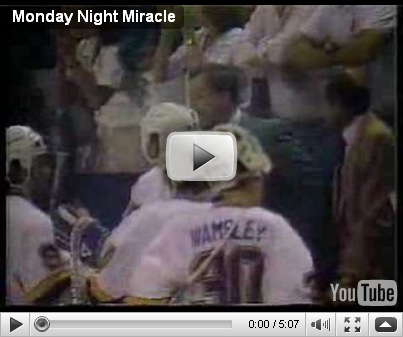
Wickenheiser’s most famous goal came in the Blues’ “Monday Night Miracle” in Game 6 of the 1986 Campbell Confrence Finals

After a season in Vancouver, a single game with the Rangers, parts of two in Washington, as well as time on the Canadian national team, he was out of the NHL.

Wix_1 Wickenheiser with the Washigton Capitals – HHOF photo

He would play in Italy in 1990-91 and share the next season with a pair of German league teams as well as an Austrian club.

Returning to North America,  he played a season each in the IHL with Peoria (1992-93) and Fort Wayne (1993-94).

Wickenheiser would get a drastic change in life that summer when he had surgery to remove a cyst from his left wrist. The cyst was found to bee malignant, forcing him to retire from playing hockey and seek treatment for bone cancer.

He remained cancer free for three years, until the dreaded disease returned in the form of a lemon size tumor in his lung. Nine months later, cancerous lesions were found in his brain. Both forms were inoperable.

After a lengthy battle, Doug Wickenheiser lost his battle on January 12, 1999. He was just 37 years old and left behind his wife and three daughters.

Even though his NHL career never reached the level of expectation from that draft day in 1980, Wickenheiser’s dedication to the game and community involvement won’t be forgotten.

After his passing the Regina Pats retired his No. 12 jersey and an arena in Regina is named after him.

The WHL’s humanitarian of the year award was renamed the Doug Wickenheiser Memorial Trophy in May 2001.

With such a great involvement with his adopted community of St. Louis, the Mid-States Hockey Association created a tournament in his name (The Wickenheiser Cup) for the lower-tier/small high school championship.

The Blues set up the Wick 14 Fund (Wickenheiser wore #14 in St. Louis) just prior to his passing in 1998. It has been since renamed the St. Louis Blues 14 Fund.

imageA commemorative banner also hangs from the rafters of the Scottrade Center. Only ight other Blues players have their numbers honoured or retired.

In 2004, the Regina Sports Hall of Fame inducted Doug Wickenheiser.

Related Links:

Habsworld: The Forgotten Habs - Doug Wickenheiser

Legends of Hockey

Greatest Hockey Legends

Dennis Kane

Resources

The Associated Press - June 12, 1980/April 1, 1983

The Montreal Gazette – June 12, 1980/December 22, 1983

The Regina Leader Post – September 21, 2007

Pepple, Todd: “The Last Face-Off: The Doug Wickenheiser Story”

Robinson, Larry: “Robinson For the Defence”

Wednesday, January 20, 2010

Blues 4 Canadiens 3 (OT) : Early Jump Denies Habs Two Points

image

Andy McDonald scored 3:19 into overtime to give the St. Louis Blues a 4-3 win over the Montreal Canadiens on Wednesday night.

The loss gives the Canadiens a single point, but leaves one on the table, as the battle for an Eastern Conference playoff berth continued.

The Blues jumped to an early lead, on the power play, when David Perron deflected a point shot in front of Carey Price at 2:57.

Veteran Paul Kariya put St. Louis up by two, at 3:35, cashing in on a rebound that Price couldn’t handle, and banking it off his pads.

Feeling the pressure of the Montreal fans early, the Canadiens netminder then took things into his own hands.

Price was flattened while playing the puck, by Can Janssen, and with no Georges Laraque playing, peeled off teammate Roman Hamrlik to get at the Blues’ enforcer.

Habs-vs-Blues01.preview

 0pricefite

e5818482f97b7591684e5522abc338f9e

e39c6bd363772566dbadda5f68213deae Price’s frustrations put him back in the crowd’s favour. It also got the attention of Blues’ goalie Ty Conklin, who crossed the red line to confront his counterpart and drew a minor penalty.

The incident motivated the Canadiens briefly, as Benoit Pouliot scored on the ensuing power play to put them within one.

# 51 - Canadiens vs. Blues - January 20, 2010 - 20-01-2010 - Montreal Canadiens - Photos The momentum died quickly, when Alex Steen took advantage of a poor back check by Scott Gomez and put a rebound into a wide open net at 19:47.

Price didn’t let the two goal deficit, or the lack of effort in front from his team, phase him through the second period, coming up big on the Blues scoring opportunities.

St. Louis had an opportunity to break the game open, with a 1:16 two-man advantage, late in the the period, but the Canadiens and their goalie shut them down.

Montreal’s momentum from the end of the second period carried into the third, putting pressure on Conklin and keeping the Blues to just one shot through the first 10 minutes.

The Canadiens got within one when a St. Louis turnover found the stick of Gomez, who set up Pouliot for his second goal of the night at 9:11.

The Canadiens persevered and with Price pulled, a point shot from Jaroslav Spacek deflected off the stick of Gomez, forcing overtime with just 33 seconds to go.

In overtime, Conklin continued to work his magic, denying the Canadiens Andrei Markov point blank.

Kariya then took a Canadiens turnover and fed McDonald, who fired a laser over Price’s blocker for the win.

St. Louis 5-3-1 under new coach Davis Payne, who took over when Andy Murray was fired on Jan. 2.

The Canadiens stay at .500 (23-23-5) for 11th in the conference, and head to New Jersey for a Friday encounter with Martin Brodeur and the Devils.

Three Stars: 1. T.J. Oshie 2. David Perron 3. Benoit Pouliot

Goalies: Mtl – Price (L) 4 GA 28 SA StL – Conklin (W) 3 GA 38 SA

Where’s Carey?: CJAD reports that Carey Price was not available to the media post-game.

Photos: Montreal Gazette, Canadian Press, canadiens.com

Wednesday, August 26, 2009

How a simple letter, and a bit of luck put Jimmy Devellano on top

JimmyD_book

I had the opportunity, this past week, to meet Jimmy Devellano, the Detroit Red Wings’ Senior vice-president and alternate governor.

Speaking at the Toronto chapter of SIHR (Society for International Hockey Research) monthly meeting , Devellano recanted his early life growing up in Cabbagetown and Scarborough,

Despite being an admitted lousy hockey player, his passion and quest for a career in the game drove him to write a letter to Lynn Patrick, general manager of the expansion St. Louis Blues in 1966.

Devellano just wanted the opportunity to be a scout and said that he would work for free for the team. Patrick agreed and after a year, he was a full time scout for the Blues.

After a five year tenure, he was let go by the Blues due to personnel issues. As luck would have it, the NHL was expanding again.

He made a trip to the NHL draft that July  and got in contact with the expansion New York Islanders GM Bill Torre.

After a dismal first season in Long Island, Devallano and Torre quickly scouted and drafted some of the greatest players in NHL history; Denis Potvin, Bryan Trottier, Clark Gillies and Mike Bossy.

He told the audience how drafting Mike Bossy nearly didn’t happen.

It was down to Bossy or Dwight Foster, who had led the OHL in Scoring.

Bossy had 77 goals in his last junior season, but couldn’t check.

Devallano said how coach Al Arbour told Bill Torre that it’s hard to find a big-time scorer. They had the playmaker in Trottier and the protector in Gilles. Arbour said he’d teach Bossy how to check.

“He’s the greatest, purest goal scorer that I ever saw in my life”, he said. “And Al Arbour was right, he did teach him how to check.”

A trade later for Butch Goring, were final pieces and in their eighth season, the Islanders were Stanley Cup champions.

devellano

Devellano was not around for the Islanders fourth straight Cup.

Little Caesar’s owner Mike Ilitch had bought the Detroit Red Wings in 1982 and his first move, as owner, was to hire Jim Devellano as their GM.

He was excited to be given his dream job with an Original Six team. At the time, the Red Wings were a struggling franchise and had just 2,100 season ticket holders.

“If (Jim) Balsillie were around then, he would have wanted to move the team to Hamilton,” he said.

By the start of his first season in Detroit, the Wings managed to double their season ticket sales but still had dismal attendance numbers.

The Wings battled through seasons of disappointments in the ‘80s. It didn’t phase Devellano or team owner Mike Ilitch’s confidence in him.

“I promised Mike and Marian Ilitch that we’d win the Cup in eight years. It took us fifteen.”

1983_feature In 1983, Devallano drafted his franchise player, Steve Yzerman , and began building a team around him.

He was one of the first GMs to scout seriously in Europe and the “Iron Curtain”.

Then scout Ken Holland found the likes of Sergei Fedorov, Vladimir Konstantinov, and Niklas Lidstrom. These players quickly put the Wings as a playoff contender.

He felt that the 1989 draft was one of the greatest in the team’s history, if not NHL history and by 1990, Devellano was the team’s senior vice-president.

The players were there, but they lacked the right coach to get them to the pinnacle. Ilitch wanted Mike Keenan, but Devellano didn’t.

The owner put his trust in him again and couldn’t have been more happy with his choice, Scotty Bowman.

Devellano admitted that Bowman and Yzerman had their differences.

Yzerman was a scorer but Bowman wanted him to play a more defensive roll. Bowman even wanted to trade the team’s captain to the Ottawa Senators.

Fortunately for Detroit, the two worked things out and Bowman turned Yzerman into a much better defensive centre. A Frank Selke Trophy in 2000 was proof that it worked.

Finally, in 1997, the Red Wings clinched the first of four Cups in an eleven-year period. Not to mention, they are one of the most successful teams of the last fifteen years.

Devellano then briefly spoke on the tragic limousine accident involving Vladimir Konstantinov.

He told us that both Hall-of-Famer Ted Lindsay and Konstantinov still has his own stall in the Red Wings dressing room and visits it whenever he attends games.

During the Q and A session, Mr. Devellano answered a variety of topics on former players, coaches, the Phoenix Coyotes and New York Islanders situations and even offered advice for some up and coming scouts.

True story: Ilitch and Devellano signed future Hall of Fame defenceman Brad Park away from the Boston Bruins by awarding him two Little Caesar’s franchises, in Boston, as a bonus.

I asked him if there was a player that he really wanted as a scout and the team’s GM went against him . The essential “come back to bite you in the ass” player.

He couldn’t come up with a name off hand in St. Louis but that in New York he had the upmost confidence from Bill Torre.

It was interesting to learn to that the Wings initial choice before Yzerman was hometown boy Pat Lafontaine. The Islanders picked him right ahead of Detroit.

Bob Tindale, the former head of Boston Bruins scouting also in attendance, then added that Boston wanted Keith Brown in the 1979 draft but after Chicago picked him, they had to go with their second option, Ray Bourque.

Devellano concluded that the draft relies on a lot of luck, and that in his career he has been extremely lucky.

More of Mr. Devellano’s story in hockey can be found in his book “The Road to Hockeytown, Jimmy Devellano’s Forty Years in the NHL”.


Monday, July 20, 2009

Canadiens add goaltending depth by signing Curtis Sanford

Ok, cue the music and get all the Fred Sanford jokes out.

7d4ab8f619ea29d4afa6af9114bbb823

The Montreal Canadiens picked up free-agent goaltender Curtis Sanford today, signing him to a one-year, two-way contract.

The Canadiens press release does not disclose the financial terms of the deal ,but nhlnumbers.com has him pegged at $600K.

Sanford is a career 37-37-11 with a 2.76 GAA and a .901 SvPct.

He saw more action in St. Louis before serving as a backup, in 35 games for Roberto Luongo, the last two seasons in Vancouver.

With the arrival of Andrew Raycroft in Vancouver, Sanford’s services were no longer needed by the Canucks.

sanford The 29-year-old will find himself in Hamilton as a back-up to Cedric Desjardins and likely be called up if injuries occur to Carey Price or Jaroslav Halak.

Such was the case last season with Marc Denis last season.

The Canadiens’ website also offers an interesting “by the numbers” look at the Habs’ newest goaltender.

Other tidbit: He was a team mate of Sean Avery when they played Jr. hockey with the Owen Sound Platers.